Table of Contents
- Why Standalone Pages Disappear in AI Overview Results
- Building Answer-Centric Content Chains That AI Systems Follow
- Contextual Bridges: The Internal Links AI Overviews Actually Follow
- Prioritizing Supporting Pages for Maximum AI Visibility
- Measuring Resilience: Signals Your Internal Links Are Working
The shift isn’t about creating better individual articles. It’s about building topical paths that make your site the logical source for comprehensive answers. When Google’s AI scans for information to synthesize, tightly linked clusters signal depth and authority in ways scattered blog posts never will.
This isn’t theoretical. Sites that survive AI Overviews share a pattern: their internal linking creates clear trails from broad questions to specific answers, with each page contextually supporting the next. You can see it in how they structure product comparisons, how-to sequences, and problem-solution frameworks.
Why Standalone Pages Disappear in AI Overview Results
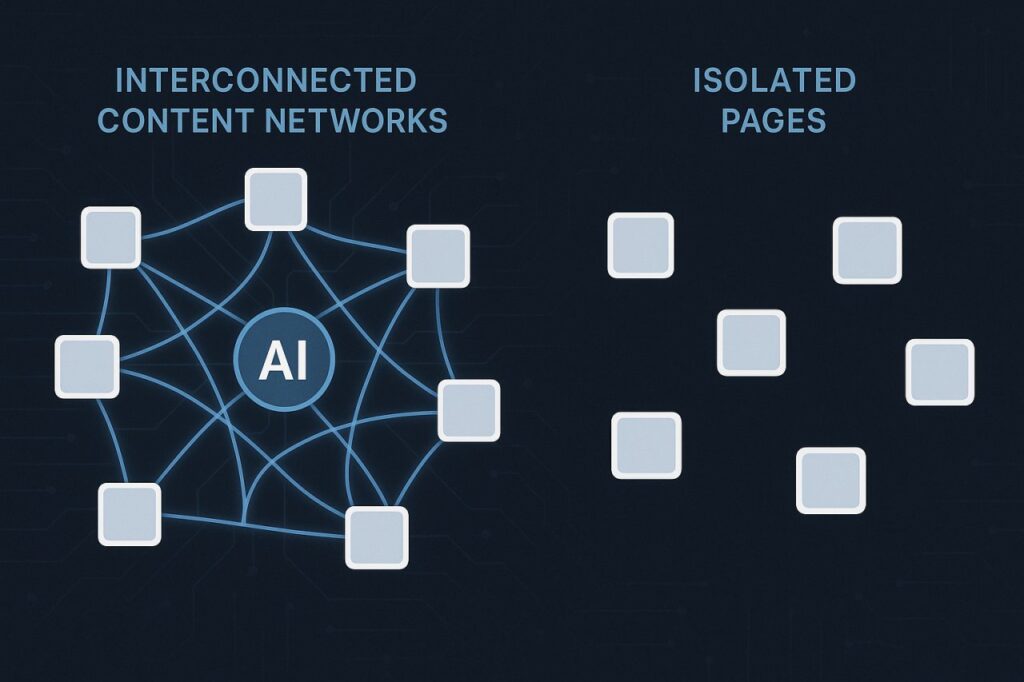
Google’s AI Overviews pull from multiple sources to construct a single answer. Your individual page competes with dozens of others for a fragment of that synthesized response. If your page exists in isolation—even if it’s well-written—it lacks the surrounding context that signals comprehensive coverage.
Think about how you research a complex topic. You don’t read one article. You follow a trail: overview to specific application to troubleshooting to alternatives. AI Overviews reward sites that mirror this natural research pattern through internal structure.
Traditional SEO optimized pages to rank independently. You targeted one keyword per page, built backlinks to that URL, and hoped it stuck on page one. That worked when users clicked ten blue links. It fails when an AI synthesizes those ten links into one answer block and only cites the sources it considers most complete.
The citation probability increases when your site offers connected depth. If Google’s AI finds your introductory guide, then discovers linked pages covering prerequisites, advanced applications, and common mistakes—all contextually tied together—you become harder to ignore. You’re not just one source among many; you’re a cluster of reinforcing signals.
Building Answer-Centric Content Chains That AI Systems Follow
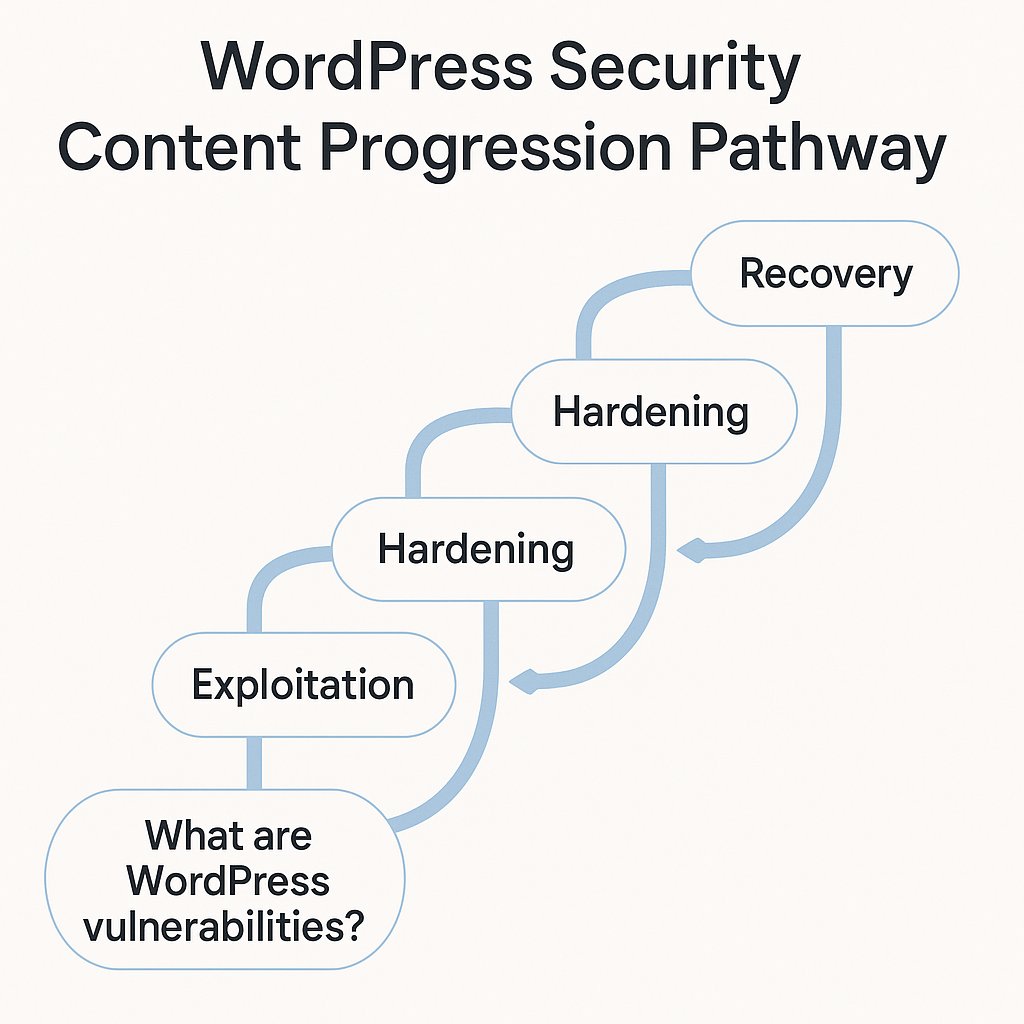
Start with the question structure, not the keyword. Map out how someone progresses from awareness to implementation. For a WordPress security topic, that might flow: What are WordPress vulnerabilities → How hackers exploit them → Step-by-step hardening → Monitoring for breaches → Recovery procedures.
Each piece answers one question completely, but links to the previous context and next logical step. The internal links aren’t decorative—they’re structural. They tell both users and AI systems this is a complete knowledge path, not a random collection.
Here’s where most WordPress sites go wrong: they create the content, then add internal links as an afterthought. Maybe they link to related posts in a sidebar widget, or rely on automatic suggestions that match keywords. Those connections are weak because they’re not answer-focused.
Instead, design the chain first. Decide which page serves as the anchor (usually the broadest, most-searched question), then build supporting pages that each expand one aspect. Link them in both directions: the anchor links to supporting details, and each supporting page links back with specific context about what it adds to the main answer.
The Hub-and-Spoke Model for AI Citation
Create one comprehensive hub page that answers the primary question at a high level. From that hub, link to 4-7 spoke pages that dive into specific scenarios, tools, or methods. Each spoke page links back to the hub and to related spokes where relevant.
This pattern works because AI Overviews often need both breadth and depth. The hub provides the overview that might get cited for context. The spokes provide the specific details that might get cited for concrete steps. Together, they increase the probability that some part of your cluster appears in the AI-generated answer.
Contextual Bridges: The Internal Links AI Overviews Actually Follow
Not all internal links carry equal weight in AI Overview visibility. The ones that matter are contextual bridges—links embedded in explanatory text that clarify how two pieces of information relate.
Compare these two approaches:
Weak: “For more on WordPress caching, see our caching guide.”
Strong: “When server response time exceeds 600ms, implementing object caching becomes essential because database queries create the primary bottleneck.”
The second example doesn’t just point to related content. It establishes a causal relationship that helps AI systems understand when and why the linked information becomes relevant. That’s the signal that gets your connected pages considered as a package.
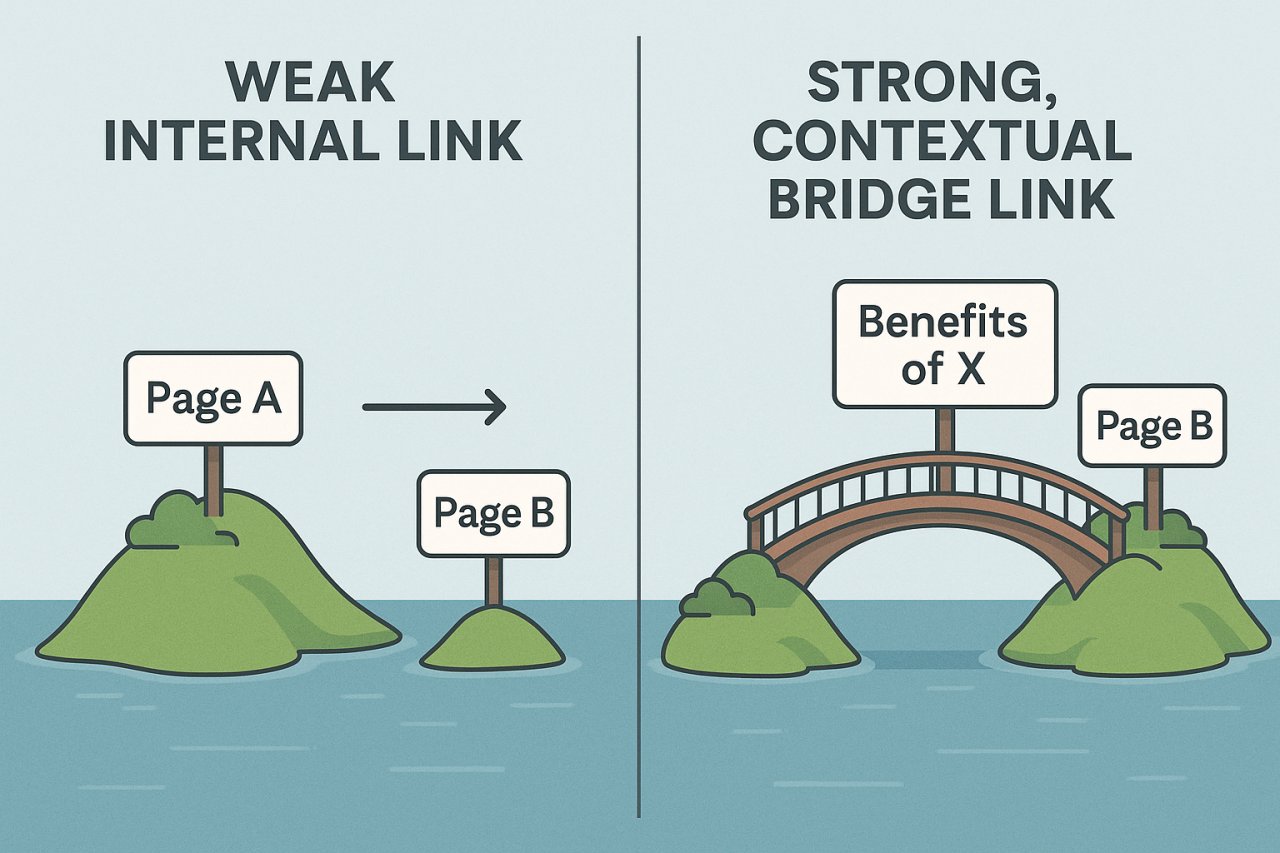
You want internal links that complete thoughts, not interrupt them. The anchor text and surrounding sentences should make it clear what problem the linked page solves and under what conditions it applies. This specificity helps Google’s AI determine whether to cite your linked page when constructing an overview for a particular query variation.
On WordPress, this means going beyond plugin-generated related post widgets. Those pull connections based on shared tags or categories—weak topical signals. You need manual links (or smart automation) that connect based on question progression and answer dependencies.
Tools like AI Internal Links can identify these contextual opportunities by analyzing semantic relationships between pages, suggesting connections where one article’s answer naturally extends or depends on another’s.
Prioritizing Supporting Pages for Maximum AI Visibility
You can’t build deep chains for every topic. Focus internal linking depth on queries where AI Overviews already appear or are likely to emerge. These typically include:
– How-to questions with multi-step answers
– Comparison queries (X vs Y)
– “What is” definitional searches with multiple aspects
– Problem-solution scenarios with prerequisites
For these query types, invest in 3-5 supporting pages per hub, each linked with contextual bridges that explain the relationship. For less complex topics, a single well-linked page still works.
Prioritize pages that answer the natural follow-up questions. Look at “People Also Ask” boxes and related searches. If your main page is about WordPress migration, supporting pages might cover: pre-migration backups, DNS propagation timing, post-migration redirects, and troubleshooting broken images. Each supports the main topic and links to it with context about its role in the process.
This supporting structure does something crucial: it gives AI Overviews multiple entry points to cite your content. Even if your main page doesn’t get the primary citation, a supporting page might get cited for a specific aspect—and that citation often includes a link that drives interested users deeper into your site.
The Multi-Layer Advantage
Pages three clicks deep from your homepage can still influence AI Overview citations if they’re properly linked into answer chains. Google’s AI doesn’t just look at top-level pages; it follows contextual connections to find the most specific, relevant answer.
This matters for WordPress sites with large content libraries. Your older, deeper content isn’t dead weight—it’s potential support for answer chains if you connect it properly. Audit your existing pages for natural progression relationships, then add the contextual bridges that were missing.
Measuring Resilience: Signals Your Internal Links Are Working
You can’t directly track AI Overview citations in Search Console yet, but you can watch for patterns that suggest your linked clusters are getting recognized. Look for increased impressions on supporting pages when hub pages rank. That indicates Google sees them as related.
Watch branded searches and direct traffic. Users who encounter your content in an AI Overview, find it useful, and want more will often search your site name or return directly. If you see traffic spikes to deep supporting pages without corresponding ranking changes, that’s a signal they’re being discovered through AI Overview citations or the knowledge exploration that follows.
Another signal: lower bounce rates on pages that are well-integrated into answer chains. Users who arrive via AI Overviews often need deeper information. If your internal links guide them logically to next steps, they’ll engage with multiple pages. If they hit a dead end, they’ll bounce back to search.
The goal isn’t to game AI Overviews—it’s to structure knowledge the way both AI systems and humans naturally follow it. When you build answer-centric chains with contextual bridges, you make your content more useful and more citable. That’s the real resilience strategy: being the obvious, comprehensive source for connected information on your topic.
Start with one core topic cluster. Map the question progression, build or identify the supporting pages, and add contextual internal links that explain relationships. Watch what happens to visibility and engagement. Then expand the approach to other topics where depth matters.