
Table of Contents
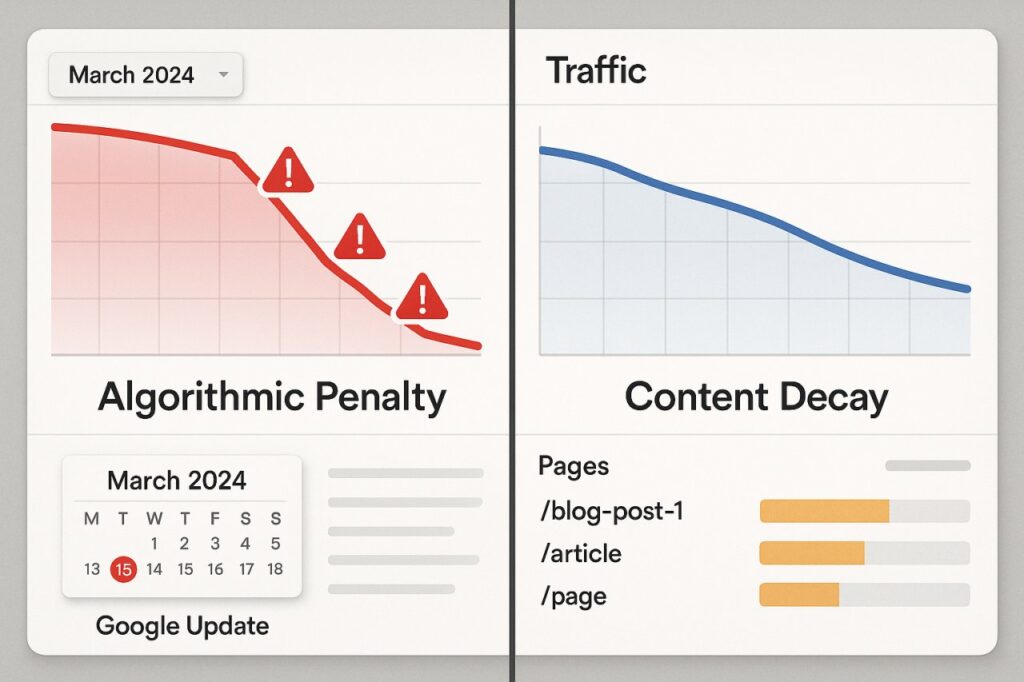
Most site owners conflate two distinct problems: algorithm-induced ranking drops that require systematic recovery, and routine content decay that calls for targeted refreshes. One demands you address how Google perceives your entire site’s authority and relevance signals. The other just needs you to update outdated information and plug gaps in coverage.
The trap is assuming every traffic dip during update season is an algorithmic hit. Sometimes your competitors simply published better content. Sometimes your 2019 guide finally aged out of relevance. And sometimes—yes—Google genuinely downgraded your site’s trustworthiness. Each scenario has different diagnostic signals and different solutions.
Read the Traffic Pattern Before You React
Start by pulling Search Console data for the 28 days before and after the suspected update date. Don’t just look at the overall traffic line. Break it down by individual queries and landing pages.
If you see broad erosion across dozens of unrelated queries, especially queries where your pages used to rank in positions 1-5, you’re likely dealing with an algorithmic adjustment. Google’s core updates often recalibrate how they weight expertise signals, and that hits entire domains, not isolated pages. You’ll notice drops on your best-performing content and your mediocre stuff alike.
If instead you see query-specific declines—where five or six closely related search terms lost rankings while the rest of your site held steady—that’s usually content staleness or a competitor leap. Maybe someone published a 2025 guide and yours still references 2022 data. Maybe they covered a sub-topic you ignored.
Query-level changes also show up when Google shifts intent interpretation. A keyword that used to pull up how-to guides might now favor product comparisons. Your content didn’t get worse; the game just moved. That’s a refresh situation, not an update recovery project.
One concrete tell: check if your click-through rate held steady even as impressions dropped. If CTR stayed flat or rose slightly, Google didn’t demote you for quality reasons—they just started showing your page for different (often fewer) queries. That’s a content-market fit issue, not an authority problem.
When Content Refresh Is the Right Move
Content refresh works when the information itself is the weak point, not your site’s overall standing with Google. You’re fixing the accuracy, depth, and relevance of specific pages, usually one at a time.
Run this test: open your declined pages in an incognito window and search the primary keyword. Look at the top three results. If they’re covering angles you missed, citing newer data, or offering tools and resources you don’t mention, your content got outcompeted. Google didn’t punish you algorithmically—your page just isn’t the best answer anymore.
Refresh candidates typically share these traits: they rank on page two or three (positions 11-30), they lost rankings gradually over months rather than overnight, and the queries themselves haven’t shifted intent. The content is fundamentally sound but incomplete or dated.
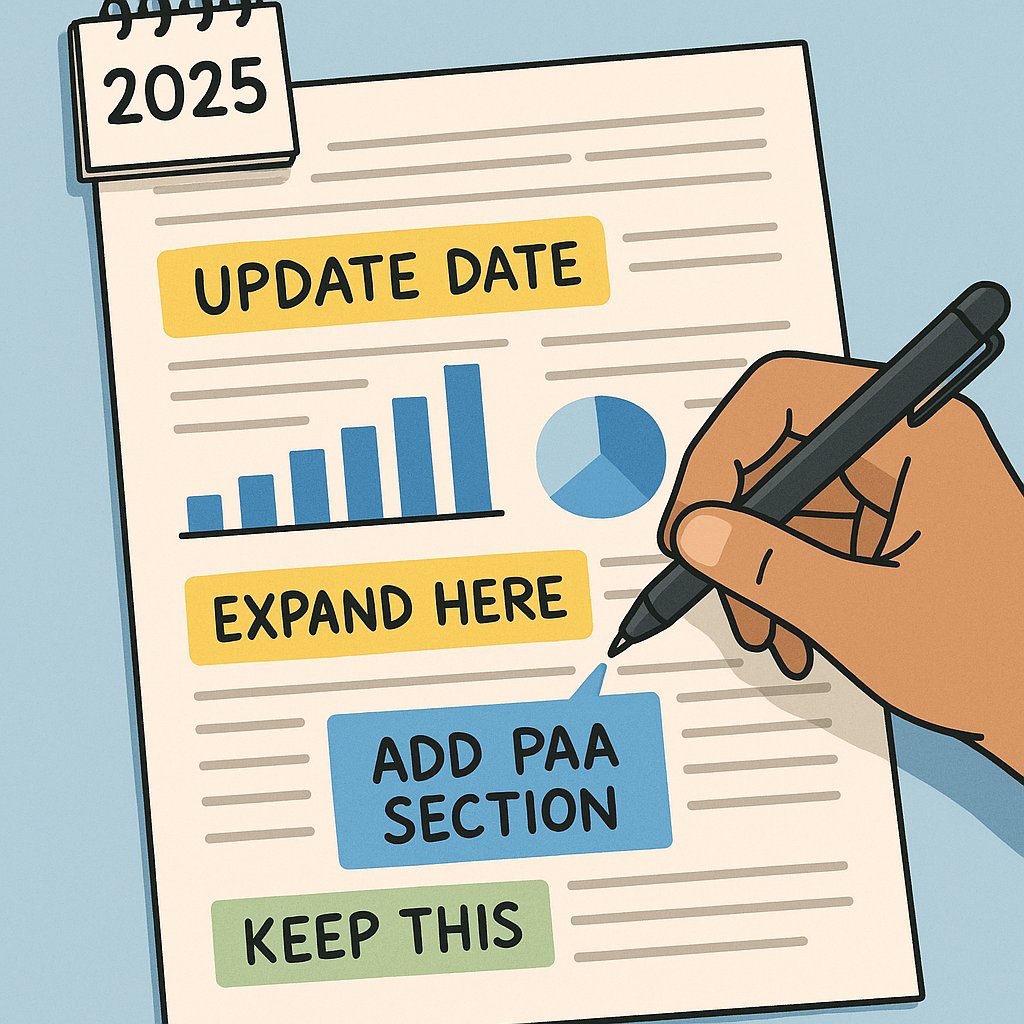
Your refresh workflow should hit these elements: update all statistics and examples to current year, add sections covering new developments in the topic since you first published, and expand thin sections where top-ranking competitors go deeper. Don’t rewrite from scratch. Preserve what works—your intro, your structure, your voice—and layer in the gaps.
One underused tactic: look at “People Also Ask” boxes for your target keyword. If those questions changed since you published, your content is missing newly relevant angles. Add subsections addressing them. This fixes the content-market mismatch without requiring a philosophical rethink of your site.
When You Need Full Google Update Recovery
Algorithm recovery is a different beast. You’re not fixing individual content gaps—you’re addressing systemic signals that caused Google to downgrade your site’s trustworthiness or expertise. This usually means the problem is in how your content connects, how your site demonstrates authority, or how your pages align with search intent at scale.
The clearest indicator: widespread ranking drops across multiple topic clusters within 48 hours of a confirmed core update. If your site lost visibility on twenty different keywords spanning three different content pillars, Google recalibrated something about how they evaluate your domain.
Another signal is average position drop without impression loss. You’re still showing up for the same queries, but Google pushed you from position 3 to position 8 across the board. That’s not a content problem—it’s a trust or relevance signal issue.
Google’s Helpful Content system, which is now part of core ranking, heavily weighs whether content demonstrates first-hand expertise and whether it’s written primarily for users or for search engines. If your traffic crashed after a core update, audit your content for these anti-patterns: excessive keyword targeting in headings, thin introductory paragraphs that don’t deliver immediate value, and lack of original insight or data.
Recovery requires site-level fixes. You might need to prune low-quality pages that dilute your expertise signals. You might need to consolidate fragmented content that’s competing with itself. And you almost certainly need to strengthen the contextual connections between your best pages—show Google how your content builds a cohesive knowledge base, not just a collection of isolated articles.
The Priority Workflow: Which Pages to Fix First
Whether you’re refreshing or recovering, you can’t fix everything at once. Prioritize based on potential impact, not sentimental attachment to content.
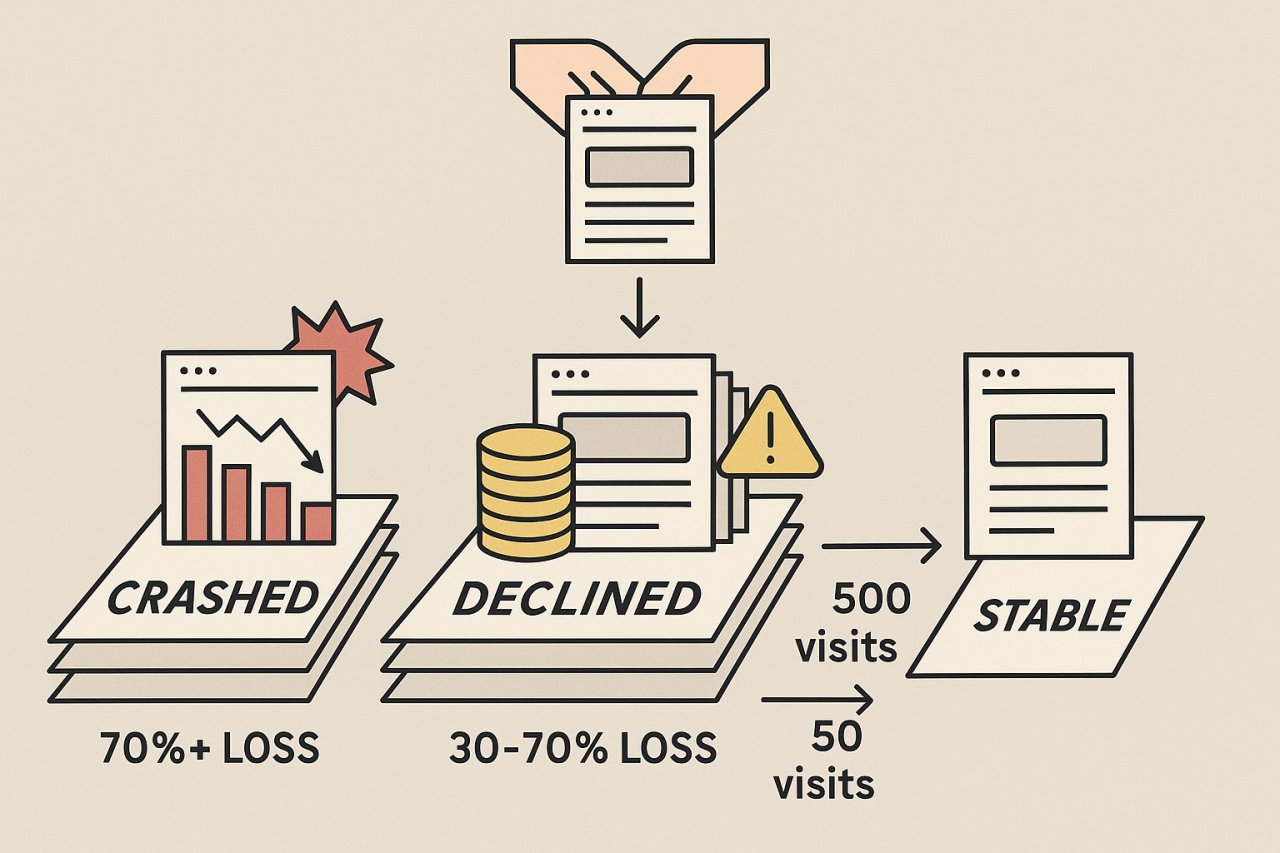
Start by tagging pages into three buckets using Search Console: “crashed” (lost 70%+ traffic), “declined” (lost 30-70%), and “stable.” Focus exclusively on the crashed and declined groups. Stable pages are fine for now.
Within those groups, rank by historical traffic value. A page that used to deliver 500 visits per month and now gets 50 is worth more attention than one that dropped from 20 to 5. Pull the numbers, sort descending, and work the top twenty.
For each priority page, run this diagnostic: Does it still rank in the top 20 for its primary keyword? If yes, it’s a refresh candidate—you’re close to recovery and just need content improvements. If it fell completely out of the top 50, you likely have an intent mismatch or a more serious quality issue.
Now look at internal link context. Pages that receive strong internal links from your other high-authority content but still lost rankings often have on-page issues: outdated information, thin content, or poor user signals. Pages that rank well for their keyword but have weak internal linking might just need better contextual connections to the rest of your site. Tools like AI Internal Links can automate this process by identifying where your content should be cross-referenced and building those connections systematically.
For update recovery specifically, group your crashed pages by topic cluster. If an entire cluster dropped together, the problem is usually thematic—Google doesn’t see you as authoritative in that subject area. You’ll need to strengthen the whole cluster: add depth to your pillar content, build more internal links between related articles, and potentially add expert contributors or original research to demonstrate expertise.
Technical Signals to Check Alongside Content
Don’t ignore technical factors while you’re diagnosing. Core Web Vitals issues won’t cause a traffic crash by themselves, but they amplify ranking instability when combined with content weaknesses. Check your PageSpeed Insights scores for your top declined pages. If Largest Contentful Paint is above 3 seconds or Cumulative Layout Shift is flagged, fix those first—they’re easy wins that remove obstacles to recovery.
Also verify your pages aren’t accidentally blocked or de-indexed. It sounds basic, but I’ve seen cases where traffic dropped because a developer added a noindex tag during site maintenance and forgot to remove it. Check the Coverage report in Search Console. If pages suddenly show “Excluded” status, you have a technical issue, not a content one.
Make the Call and Commit
Here’s the decision framework: If more than 40% of your traffic decline happened within one week of a confirmed Google update, and it affected multiple topic areas, treat it as algorithmic and pursue recovery. If the decline was gradual or isolated to specific queries, treat it as content staleness and refresh those pages.
Don’t hedge by doing both halfway. Algorithm recovery demands site-level thinking—pruning weak content, strengthening topical authority, building better internal architecture. Content refresh is page-level—updating facts, expanding coverage, improving depth. Mixing the two dilutes your effort.
Start with your top twenty priority pages. If you’re refreshing, aim to ship improvements within two weeks and monitor for ranking changes over the next month. If you’re recovering from an update, expect a longer timeline—core updates often take 3-6 months to fully stabilize, and you need multiple update cycles to confirm recovery. Execute your fixes, then wait for the next core update to see if Google reassesses your site favorably.
The worst move is analysis paralysis. Make your best diagnosis with the data you have, commit to a fix, and track the results. You’ll know within 30 days if you chose right.