
Table of Contents
- Title Tags: Your 60-Character Sales Pitch to Google
- Meta Descriptions: The Underrated CTR Weapon
- Header Tags: Building a Logical Content Hierarchy
- Keyword Placement: Strategic, Not Obsessive
- URL Structure: Keep It Clean and Keyword-Rich
- Internal Linking Strategy: The Most Underutilized On-Page Factor
- Content Quality: The Foundation Everything Else Builds On
- The Implementation Gap: Why Checklists Fail
Here’s what nobody tells you: the checklist itself isn’t the problem. You can find a dozen solid on-page SEO guides with the same fundamental elements. What separates sites that dominate search results from those that languish on page three isn’t knowledge — it’s implementation consistency and strategic depth.
This guide strips away the generic advice and focuses on what actually moves the needle. We’ll cover the essentials, yes, but more importantly, we’ll explore how to layer these elements together to create pages that Google can’t ignore.
Title Tags: Your 60-Character Sales Pitch to Google
Your title tag is the single most important on-page element. Period. It’s the first thing users see in search results and the primary signal Google uses to understand page relevance.
Front-Load Your Primary Keyword
Put your main keyword as close to the beginning as possible. Not because of some ancient SEO superstition, but because Google truncates titles at around 60 characters. If your keyword is buried at position 50, mobile users might never see it.
Bad: Learn Everything You Need to Know About On-Page SEO Checklist Strategies
Good: On-Page SEO Checklist: 15 Elements That Drive Rankings
The second version delivers clarity immediately. Users know exactly what they’re getting.
Add Modifiers That Match Search Intent
Words like “guide,” “checklist,” “how to,” “best,” and the current year naturally improve click-through rates. They signal freshness and comprehensiveness. But here’s the nuance: use modifiers that align with your page’s actual search intent.
If someone searches on-page SEO checklist, they want a systematic list. Give them that in the title. If they search how does on-page SEO work, they want education, not a checklist.
Make Every Title Unique
Duplicate titles across your site are a ranking liability. They confuse Google about which page should rank for what query. Run a crawl with Screaming Frog or Sitebulb quarterly and hunt down duplicates mercilessly.
Meta Descriptions: The Underrated CTR Weapon
Let’s debunk a myth: meta descriptions aren’t a direct ranking factor. Google’s said this repeatedly. But they absolutely influence rankings indirectly through click-through rate. A compelling meta description steals clicks from competitors, which signals to Google that your result is more relevant.
Write for Humans, Not Algorithms
Too many meta descriptions read like keyword-stuffed nightmares. Write yours like ad copy. What’s the unique benefit of clicking your result? What question will you answer that competitors won’t?
Keep it under 155 characters to avoid truncation. Use active voice. Include a call-to-action when appropriate: “Learn how,” “Discover why,” “Get the checklist.”
Include Your Target Keyword Naturally
When your keyword appears in the meta description and matches the user’s query, Google bolds it in the search results. That visual emphasis draws the eye. But don’t force it — readability trumps keyword placement every time.
Header Tags: Building a Logical Content Hierarchy
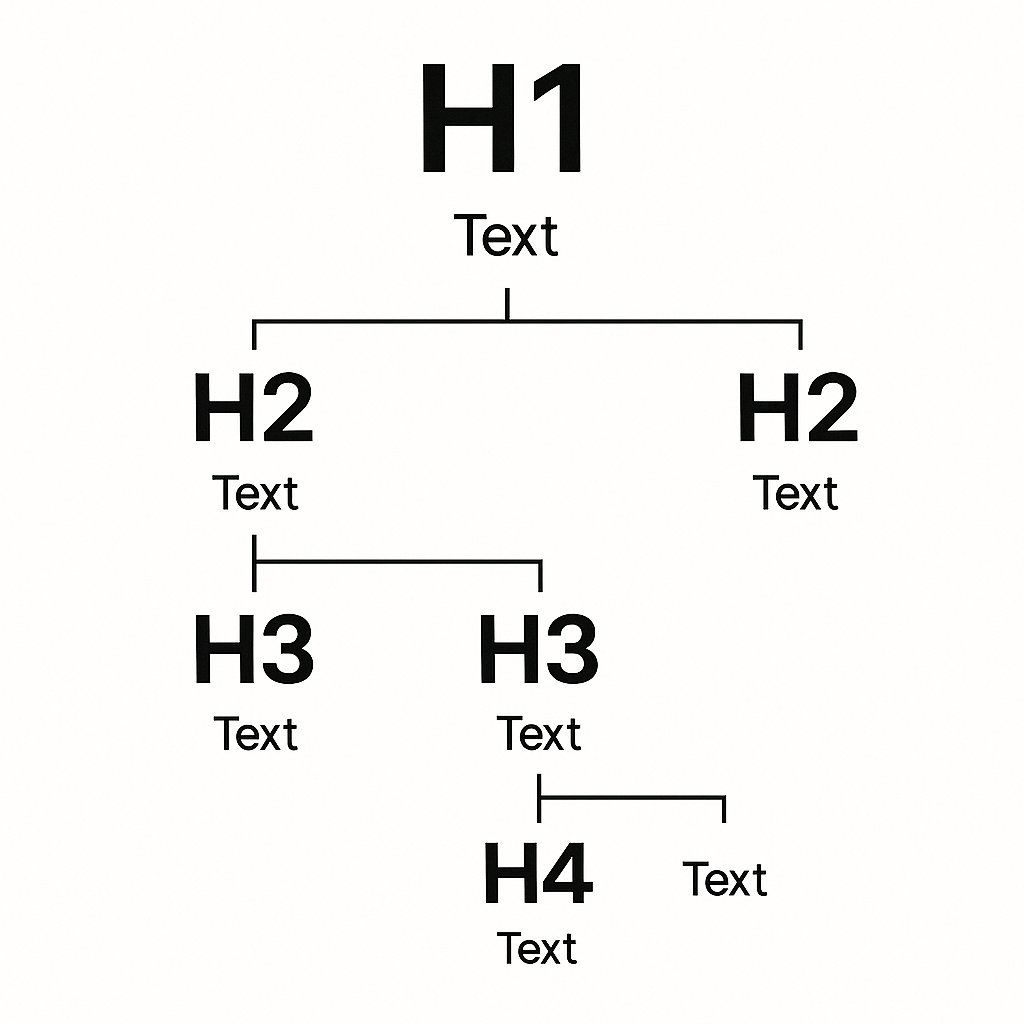
Header tags (H1, H2, H3, H4) do two things: they help users scan your content, and they give Google a clear outline of your page’s structure.
One H1 Per Page — Make It Count
Your H1 should match or closely mirror your title tag. It reinforces the page’s primary topic. Some themes automatically generate H1s from your title, which is fine. Just verify it’s happening.
Never use multiple H1s. It dilutes topical focus and confuses both users and search engines about what the page is actually about.
Use H2s to Break Content Into Major Sections
Each H2 should represent a distinct subtopic within your main theme. Think of them as chapter titles. They should be descriptive enough that someone skimming only your H2s could understand your article’s flow.
Avoid generic H2s like “Introduction” or “Overview.” Use specific, keyword-rich alternatives: “Why Header Tags Matter for SEO” tells the reader exactly what’s coming.
H3s and H4s Add Depth Without Clutter
Use H3s to break down H2 sections into smaller chunks. If you’re explaining title tag optimization (H2), your H3s might cover character limits, keyword placement, and CTR optimization individually.
H4s are optional and rarely necessary unless you’re writing genuinely comprehensive, long-form content. Don’t force header hierarchy just to check a box.
Keyword Placement: Strategic, Not Obsessive
Keyword stuffing died years ago. Modern on-page SEO focuses on natural keyword placement in strategic locations.
The Big Four Placement Zones
Your primary keyword should appear in:
- The first 100 words of your content
- At least one H2 or H3 heading
- The URL slug
- Image alt text (where contextually appropriate)
Beyond that? Write naturally. Google’s natural language processing is sophisticated enough to understand semantic relationships and topic relevance without seeing your exact keyword every 150 words.
Embrace Semantic Keywords and Variations
If your main keyword is on-page SEO checklist, related terms might include on-page optimization factors, on-site SEO elements, page-level ranking signals. Use these variations throughout your content.
They’re not just synonyms — they’re proof to Google that you understand the topic comprehensively. Tools like Surfer SEO or Clearscope can identify these semantic terms, but honestly, writing with genuine expertise naturally incorporates them.
Keyword Density Is a Distraction
Forget about hitting a specific keyword density percentage. It’s a relic from 2010 SEO. Focus instead on topical coverage depth. Are you answering the user’s question thoroughly? Are you covering related subtopics that demonstrate expertise?
If your content genuinely addresses the search intent, keyword usage will take care of itself.
URL Structure: Keep It Clean and Keyword-Rich
Your URL should be a simplified, readable version of your page topic. That’s it.
Short, Descriptive, Keyword-Focused
Good: yoursite.com/on-page-seo-checklist
Bad: yoursite.com/blog/2026/01/post-12345-everything-you-need-to-know-about-comprehensive-on-page-seo
Remove stop words (a, the, and, or) unless they’re part of your exact keyword phrase. Use hyphens, not underscores. Keep it under 60 characters when possible.
Avoid Unnecessary URL Parameters
If your CMS generates URLs with dates, categories, or session IDs by default, change that setting immediately. These elements add no SEO value and create longer, uglier URLs that perform worse in search results.
Internal Linking Strategy: The Most Underutilized On-Page Factor
Here’s where most on-page checklists get lazy. They’ll mention internal linking in a single bullet point and move on. That’s a massive missed opportunity.
Internal linking is how you distribute authority, establish topical relationships, and guide both users and crawlers through your content ecosystem. It’s not optional — it’s foundational.
Link Deep, Not Just to Your Homepage
Most sites over-link to their homepage and under-link to deep content. Flip that ratio. Your most valuable pages — those targeting high-intent keywords — should receive links from relevant supporting content.
Every time you publish a new article, ask: Which existing pages would this naturally support? Which existing pages should link here?
Use Descriptive, Keyword-Rich Anchor Text
Don’t waste internal links on anchors like “click here” or “read more.” Use descriptive phrases that tell Google what the target page is about: “our complete guide to meta tag optimization” is far more valuable.
But balance keyword optimization with natural readability. If the anchor feels forced, rewrite the surrounding sentence.
Automate What You Can
Manually managing internal links across hundreds or thousands of pages is unrealistic. This is where automation adds genuine value. Tools like AI Internal Links can analyze your content and suggest relevant linking opportunities based on semantic relationships — saving hours of manual work while improving link structure consistency.
The goal isn’t to link everything to everything. It’s to create strategic pathways that reinforce topical authority and distribute PageRank where it matters most.
Review and Update Quarterly
Internal linking isn’t set-it-and-forget-it. As you publish new content, older pages can become orphaned or under-linked. Schedule quarterly audits to identify these gaps and strengthen your link architecture.
Content Quality: The Foundation Everything Else Builds On
Here’s an uncomfortable truth: perfect technical on-page SEO won’t save mediocre content. You can nail every element on this checklist and still rank poorly if your content doesn’t deliver genuine value.
Match Search Intent Precisely
Before writing a single word, understand what users actually want when they search your target keyword. Are they looking for information, comparison, instruction, or a transaction?
Search your keyword and analyze the top 10 results. What format do they use? How deep do they go? What questions do they answer? Your content needs to match or exceed that standard.
Add Unique Value
Don’t just regurgitate what’s already ranking. What can you add that competitors haven’t?
- Original research or data
- Case studies from your experience
- Contrary opinions backed by reasoning
- Deeper technical explanation
- Better visual explanations
Google’s algorithms increasingly reward content that demonstrates experience, expertise, authority, and trustworthiness (E-E-A-T). Generic, surface-level content gets buried.
Update Regularly
Content decay is real. Information becomes outdated, competitors publish better resources, and Google’s expectations evolve. Set reminders to refresh high-value pages annually — update statistics, add new sections, improve examples.
A refreshed publish date signals freshness. But only update when you’ve actually improved the content. Fake updates don’t fool anyone.
The Implementation Gap: Why Checklists Fail
You now have a comprehensive on-page SEO checklist. Most people will read this, nod along, and change nothing. Here’s why: the gap between knowing and doing is massive.
The sites that dominate search results aren’t the ones with the best checklist — they’re the ones that systematically implement it across every page.
Start with your highest-traffic pages. Audit them against this checklist. Fix the gaps. Then move to your highest-potential pages — those ranking 11-20 where small improvements could trigger significant gains.
Don’t try to optimize everything at once. Prioritize ruthlessly. Focus on pages that actually drive business value.
On-page SEO isn’t sexy. It’s methodical, detail-oriented work. But it’s also the foundation that every other SEO tactic builds on. Get this right, and everything else — content marketing, link building, technical SEO — becomes more effective.
The question isn’t whether you know what to do. The question is whether you’ll actually do it.