

Internal linking remains one of the most underutilized yet powerful SEO strategies for improving search rankings, user experience, and site authority. As search engines evolve with AI-driven algorithms and semantic understanding, the way we approach internal linking in 2026 demands more sophistication than ever before. This comprehensive guide explores the best practices that separate high-performing sites from those struggling to gain traction in search results.
The fundamentals haven’t changed — internal links distribute authority, guide crawlers, and help users navigate your content — but the execution has become far more nuanced. Modern internal linking requires strategic planning around anchor text variation, contextual relevance, crawl budget optimization, and topical authority. Whether you’re managing a small business blog or an enterprise WordPress site with thousands of pages, mastering these practices will give you a measurable competitive advantage.
Why Internal Linking Matters More Than Ever in 2026
Search engines have become incredibly adept at understanding content relationships and topical relevance. Google’s continuous algorithm updates emphasize site structure, content depth, and the semantic connections between pages. Internal linking serves as the primary mechanism for communicating these relationships to search crawlers.
The Evolution of Search Engine Understanding
Search algorithms now prioritize topical authority over isolated keyword targeting. When you create comprehensive content hubs connected through strategic internal links, you signal to search engines that your site offers genuine expertise on specific subjects. This topical clustering approach has proven far more effective than outdated siloed content strategies.
The shift toward AI-powered search results has amplified the importance of clear site architecture. Language models need to understand how your content pieces relate to each other, and internal links provide the most explicit signals for these connections. Sites with well-structured internal linking consistently outperform those with random or minimal linking patterns.
Link Equity Distribution and PageRank Flow
Every page on your site possesses a certain amount of authority, often referred to as link equity or PageRank. Internal links distribute this authority throughout your site, potentially elevating pages that might otherwise remain buried in search results. Strategic internal linking ensures your most valuable pages receive adequate authority to compete for competitive keywords.
The distribution isn’t equal or automatic. Pages linked from your homepage or other high-authority pages receive more equity than deeply nested content. Understanding this flow allows you to architect your site deliberately, channeling authority where it matters most for your business objectives.
User Experience and Engagement Metrics
Beyond algorithmic benefits, internal links profoundly impact user behavior metrics that indirectly influence rankings. Well-placed internal links reduce bounce rates, increase pages per session, and extend average visit duration. These engagement signals tell search engines that your content satisfies user intent.
Users who discover related content through internal links are more likely to convert, whether that means subscribing, purchasing, or becoming repeat visitors. The navigational convenience of contextual internal links creates a seamless experience that keeps visitors engaged with your content ecosystem.
Descriptive Anchor Text: The Foundation of Effective Internal Links
Anchor text remains one of the most powerful signals you can send to both users and search engines about the linked page’s topic. In 2026, the sophistication with which you craft anchor text can dramatically impact your internal linking effectiveness.
Natural Language Over Exact Match Keywords
The days of cramming exact-match keywords into every anchor are long gone. Modern best practices favor natural, descriptive phrases that genuinely preview the linked content. Instead of using ‘SEO tips’ as anchor text repeatedly, vary your approach with phrases like ‘strategies to improve organic visibility’ or ‘techniques for better search rankings.’
This variation serves multiple purposes. It prevents over-optimization penalties, reads more naturally to human visitors, and helps search engines understand the nuanced context around your links. Semantic variations actually strengthen topical relevance rather than diluting it.
Contextual Anchor Text That Adds Value
The best anchor text integrates seamlessly into the surrounding content while providing clear expectations about the destination page. Avoid generic phrases like ‘click here’ or ‘read more’ that offer no contextual value. Instead, make the anchor text itself informative and compelling.
For example, when linking to a guide about technical SEO, anchor text like ‘optimizing site speed and crawlability’ tells readers exactly what they’ll find while reinforcing the target page’s topical focus. This descriptive approach benefits SEO while improving user experience through clarity.
Balancing Brand Terms and Topic Keywords
While descriptive keyword phrases should dominate your internal linking strategy, don’t neglect brand terms and variations. Mixing branded anchors with topical phrases creates a natural linking profile that mirrors how real users and external sites would link to your content.
This balance becomes especially important for commercial pages and service offerings. A healthy mix might include product names, category descriptors, and problem-solution phrases that reflect different stages of the customer journey.
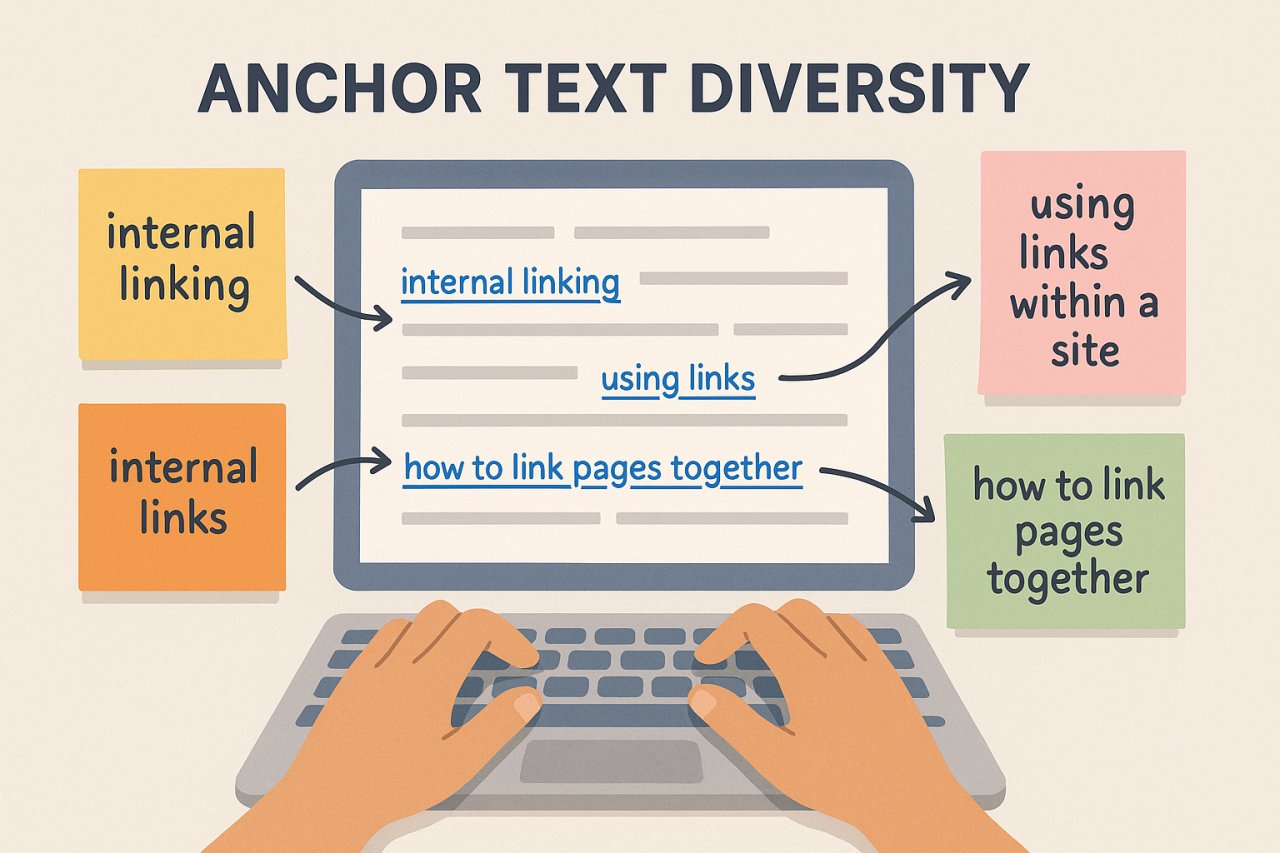
Anchor Text Diversity Across Your Site
When multiple pages link to the same destination, vary the anchor text to avoid appearing manipulative. If ten pages all link to your homepage using identical anchor text, it looks unnatural and potentially spammy. Instead, use different relevant phrases that each highlight a unique aspect of the target page.
This diversity also helps search engines understand the multifaceted nature of your content. A comprehensive guide might legitimately be described through multiple lenses — all valid, all valuable for semantic understanding.
Contextual Placement and Relevance Signals
Where you place internal links within your content matters as much as the anchor text itself. Strategic positioning enhances both SEO value and user engagement.
Early Content Links Carry More Weight
Links appearing in the first few paragraphs of your content generally carry more weight than those buried at the bottom. Search engines recognize that prominent placement suggests greater relevance and importance. When linking to truly essential related content, position those links where readers will encounter them early.
This doesn’t mean cramming your opening paragraphs with links. Rather, it means thoughtfully integrating the most relevant connections where they naturally fit within your content flow.
In-Content Links Versus Navigation Links
Contextual links within your main content body provide stronger relevance signals than navigation menus or footer links. While structural navigation remains important for site architecture, editorial links embedded naturally in your content demonstrate genuine topical relationships.
Search engines can distinguish between these link types and weight them accordingly. A link within a paragraph discussing related concepts carries more semantic value than the same link appearing in a site-wide footer.
Relevance Between Source and Target Pages
The topical relevance between the linking page and destination page amplifies the value of internal links. Linking from a guide about email marketing to a related piece on segmentation strategies makes perfect sense. Linking that same email marketing guide to an unrelated post about graphic design dilutes the relevance signal.
Before adding an internal link, ask whether the connection genuinely serves your readers. If the link feels forced or tangential, it probably weakens rather than strengthens your internal linking structure.
Optimal Link Density Per Page
There’s no magic number for internal links per page, but balance matters. Pages with 2-5 contextual internal links typically perform well, though longer comprehensive content can support more. The key is ensuring each link adds value rather than cluttering the reading experience.
Excessive linking creates decision paralysis and dilutes the authority passed to any single destination. Focus on quality connections rather than maximizing link count.
Optimizing Crawl Depth and Site Architecture
How search engines crawl and index your site depends heavily on your internal linking structure. Optimizing for crawl efficiency ensures all your valuable content gets discovered and properly evaluated.
The Three-Click Rule for Important Pages
Every important page on your site should be accessible within three clicks from your homepage. Pages buried deeper in your site architecture receive less crawl priority and accumulate less authority. Strategic internal linking can flatten your site structure, bringing valuable content closer to the surface.
For large sites with thousands of pages, achieving this for every page becomes impractical. Prioritize your most important commercial pages, cornerstone content, and high-performing articles for preferential treatment in your linking hierarchy.
Avoiding Orphan Pages Through Systematic Linking
Orphan pages — those with no internal links pointing to them — essentially don’t exist in Google’s eyes. These pages rarely rank because crawlers can’t discover them efficiently, and they receive no internal authority. Regular audits should identify orphan pages so you can integrate them into your linking structure.
For WordPress sites particularly, new content can easily become orphaned if you don’t systematically link to it from relevant existing pages. Establishing processes to connect new content prevents this common oversight.
Managing Crawl Budget on Large Sites
For sites with thousands or tens of thousands of pages, crawl budget becomes a real concern. Search engines allocate limited resources to crawling your site, and inefficient internal linking can waste this budget on low-value pages while important content goes uncrawled.
Prioritize internal links to your most valuable pages while using robots.txt, noindex tags, and strategic link removal to guide crawlers away from thin or duplicate content. Your internal linking architecture should reflect your content priorities.
Deep Linking to Specific Sections
While linking to main pages forms the backbone of your strategy, don’t neglect deep links to specific sections or subtopics within longer content. These deep links help establish comprehensive topical coverage and provide users with precisely relevant resources.
When appropriate, link to specific sections using anchor links that jump directly to the relevant content. This precision benefits both user experience and topical relevance signals.
Topic Clusters and Hub-Spoke Models
Organizing your content into topic clusters connected by strategic internal links has become the gold standard for building topical authority in 2026.
Creating Pillar Content as Central Hubs
Pillar pages serve as comprehensive overviews of broad topics, linking out to more detailed cluster content on specific subtopics. These hub pages should be substantial (typically 3,000+ words) and cover the topic comprehensively at a high level.
The pillar content approach signals to search engines that you’ve covered a topic thoroughly from multiple angles. When properly executed with supporting cluster content, this architecture dramatically improves rankings for competitive head terms.
Cluster Content That Supports Your Pillars
Each cluster page should dive deep into a specific aspect of the broader pillar topic. These pages link back to the pillar and often to each other when relevant. This creates a tightly woven content network that reinforces your topical expertise.
For example, a pillar page about content marketing might have cluster pages covering content strategy, content distribution, content metrics, video content, and content optimization. Each cluster strengthens the overall topical authority of the entire hub.
Bidirectional Linking Patterns
The most effective topic clusters use bidirectional linking — pillar pages link to clusters, and clusters link back to pillars. This creates clear hierarchical relationships while ensuring authority flows in both directions. The pattern helps search engines understand which pages are most important within each topic.
Many sites make the mistake of only linking from pillar to cluster without return links, weakening the architectural clarity of their content organization.
Lateral Links Between Related Clusters
Beyond hub-spoke patterns, lateral links between related cluster pages add valuable context. When two cluster pages discuss complementary subtopics, linking between them helps users discover related information and strengthens the overall topic network.
These lateral connections should be selective and genuinely relevant. Random linking between unrelated clusters dilutes the topical focus you’re trying to establish.
Scaling Topic Clusters Across Your Site
As your site grows, you’ll develop multiple topic clusters around different core themes. The same principles apply at scale — maintain clear pillar-cluster relationships within each topic while occasionally linking between clusters when genuine topical overlap exists.
For sites managing dozens of topic clusters, automation becomes increasingly valuable. Tools like AI Internal Links can analyze your content and suggest relevant connections that maintain topical coherence while saving hours of manual work.
Common Internal Linking Pitfalls to Avoid
Even experienced SEO professionals fall into traps that undermine their internal linking effectiveness. Recognizing and avoiding these mistakes protects your rankings and user experience.
Over-Optimization Through Excessive Exact Match Anchors
Repeatedly using identical keyword-rich anchors to the same page looks manipulative to search engines. This over-optimization can trigger algorithmic penalties or at minimum reduce the effectiveness of your links. Natural variation in anchor text prevents this issue while maintaining relevance signals.
Monitor your anchor text distribution to ensure no single phrase dominates your linking profile to any given page. Diversity creates a more natural, trustworthy pattern.
Linking to Irrelevant or Low-Quality Pages
Not every page on your site deserves internal links. Linking to thin content, outdated articles, or tangentially related pages dilutes your authority and confuses search engines about your topical focus. Be selective, linking only when the connection genuinely benefits users.
Regularly audit your content quality and remove internal links to pages that no longer meet your standards. Consider consolidating or removing low-performing content rather than propping it up with internal links.
Neglecting Mobile User Experience
With mobile-first indexing, how internal links function on mobile devices matters enormously. Links placed too close together create poor touch experiences. Excessive links can make mobile content feel cluttered and difficult to navigate.
Test your internal linking on actual mobile devices to ensure links are easily tappable and the overall experience remains clean and navigable.
Ignoring Link Velocity and Sudden Changes
Adding hundreds of internal links overnight can appear suspicious to search engines. When implementing a new internal linking strategy, phase the changes over time rather than making massive sudden alterations to your site structure.
Gradual implementation also allows you to monitor the impact of changes and adjust your approach based on performance data.
Using Nofollow on Internal Links
Except in very specific circumstances, internal links should never use nofollow attributes. Nofollowing internal links prevents authority flow and can create crawl inefficiencies. Reserve nofollow exclusively for external links where appropriate.
Some CMS systems or plugins incorrectly apply nofollow to internal links by default. Audit your links to ensure they’re all dofollow unless you have a specific reason otherwise.
Forgetting to Update Links When Updating Content
When you update, merge, or delete content, corresponding internal links need attention. Broken internal links harm user experience and waste crawl budget. Redirecting old URLs preserves link equity, but updating anchor text and destinations to reflect current content architecture is even better.
Establish processes for reviewing internal links whenever you make significant content changes. This ongoing maintenance prevents your linking structure from degrading over time.
Measuring Internal Linking Success
Implementing best practices means little without measuring their impact. Several metrics reveal whether your internal linking strategy is working.
Tracking Rankings for Target Keywords
The most direct measure of success is improved rankings for pages you’ve strategically linked to. Monitor keyword positions for pages receiving enhanced internal linking attention. Improvements typically appear within a few weeks to months, depending on your site’s overall authority.
Compare performance of pages with strong internal linking against similar content with weaker linking. This controlled comparison isolates the impact of your internal linking efforts.
Monitoring Page Authority and Link Equity
Third-party SEO tools provide page authority metrics that reflect link equity distribution. Watch how authority flows through your site as you implement internal linking improvements. Pages that receive quality internal links should show authority increases over time.
These metrics aren’t perfect, but they provide useful directional indicators of whether your strategy is distributing authority effectively.
Analyzing Crawl Statistics in Search Console
Google Search Console shows which pages get crawled most frequently and which encounter errors. Improved internal linking should increase crawl frequency for important pages while helping previously orphaned content get discovered.
Review crawl stats monthly to ensure your internal linking changes are having the desired architectural impact on how search engines navigate your site.
User Behavior Metrics
Engagement metrics like pages per session, average session duration, and bounce rate reflect whether your internal links serve user needs. Effective internal linking should increase engagement as users discover more relevant content.
Segment these metrics by traffic source and landing page to understand which internal linking placements drive the most engagement. Use these insights to refine your strategy over time.
Internal linking best practices continue evolving alongside search algorithms, but the core principles remain consistent: create clear, logical connections between related content using descriptive anchor text, optimize your site architecture for both users and crawlers, and organize content into coherent topical clusters. The sites that invest time in strategic internal linking consistently outperform those that treat it as an afterthought.
In 2026, the gap between sophisticated internal linking and basic approaches has widened. With AI-powered tools and semantic search algorithms, implementing these best practices has become both easier and more critical. Whether you’re optimizing a new site or auditing an existing one, systematic attention to internal linking delivers measurable SEO improvements that compound over time. Start with your most important pages, build outward strategically, and maintain your linking structure as an ongoing priority rather than a one-time project.