
Table of Contents
- Why Long-Form Content Needs Different On-Page SEO Rules
- Start with Title Tag and Meta Description Psychology
- Heading Structure Is Your Content’s Navigation System
- Semantic SEO: Stop Optimizing for Keywords, Start Optimizing for Topics
- Internal Linking Architecture Transforms Content into Authority
- Image Optimization for Long-Form Content Isn’t Optional
- Optimize for UX Signals Google Actually Measures
Long-form articles carry enormous ranking potential, but only if you treat them like architecture projects instead of word-count sprints. Google doesn’t reward length. It rewards clarity, structure, and topical authority. Every element — from your H2 hierarchy to the internal links you weave between paragraphs — either reinforces your expertise or dilutes it.
This guide breaks down the exact on-page framework that turns comprehensive articles into ranking machines. No fluff, no theory-only advice. Just the specific optimizations that move the needle when you’re competing in high-authority SERPs.
Why Long-Form Content Needs Different On-Page SEO Rules
A 500-word post can get away with sloppy structure. A 2,500-word guide cannot.
When users land on long-form content, they scan first and read later. If your heading hierarchy doesn’t map to their mental model of the topic, they bounce. If your first three paragraphs don’t answer the implicit question behind their search, they hit back. Length amplifies structural problems — what feels like a minor H3 placement issue in a short post becomes a navigation disaster in a comprehensive guide.
Search intent for long-form queries is different, too. Someone searching “email marketing basics” wants a quick overview. Someone searching “email segmentation strategies for SaaS retention” expects depth, nuance, and examples they can implement. Your on-page optimization must signal that depth before the reader commits to scrolling.
Google’s algorithm treats long-form content as a topical authority signal — but only if the page demonstrates genuine expertise through semantic breadth, not keyword repetition. That means your on-page work shifts from keyword density to contextual richness.
Start with Title Tag and Meta Description Psychology
Your title tag isn’t just metadata — it’s a filter. In competitive SERPs, users scan dozens of titles before clicking. Yours needs to do two jobs simultaneously: match search intent exactly and hint at unique insight.
For long-form content, specificity beats cleverness. “Content Marketing Strategy” is vague. “Content Marketing Strategy for B2B SaaS: From 0 to 50K Monthly Visitors” promises a defined outcome and a clear audience. The second version attracts qualified clicks from people who actually need a 3,000-word deep dive.
Meta descriptions for long-form pieces should preview your structure. “Learn the 7-stage content strategy framework we used to scale organic traffic, from keyword clusters to conversion optimization” tells the reader what they’ll find inside and sets an expectation for comprehensive coverage. Don’t waste the space on generic promises.
Front-Load Your Primary Keyword — But Make It Natural
Place your focus keyword in the first 100 words, but don’t force it into the opening sentence. “On-page SEO for long-form content starts with…” reads like a robot wrote it. Instead, describe the problem, then name the solution.
Better: “Most 2,000+ word articles fail to rank because they ignore structural optimization. Mastering on-page SEO for long-form content fixes that.”
The keyword appears naturally, after you’ve hooked the reader with a problem they recognize.
Heading Structure Is Your Content’s Navigation System
Your H2 and H3 tags aren’t formatting tools — they’re promises to the reader about what each section delivers. Every heading should be specific enough that someone could skim only the headings and understand your argument.
Bad: “Understanding Keywords”
Good: “Semantic Keywords Matter More Than Exact Match in Long-Form SEO”
The second version tells the reader exactly what stance you’re taking and what they’ll learn. It also naturally incorporates semantic variations Google expects to see in topical content.
Use H3s to Break Dense Sections Into Scannable Chunks
After every 300-400 words under an H2, insert an H3. Not because you need more headers, but because visual rhythm matters. Long blocks of text signal “hard work ahead” to readers. Frequent subheadings create the perception of progress.
H3s also let you target long-tail variations. Under an H2 about “Keyword Research for Content Hubs,” you might have H3s like “How to Identify Cluster Topics” and “Building a Semantic Keyword Map.” Each subheading becomes a mini-ranking opportunity for more specific queries.
Never Skip H2s or Mix Hierarchy Levels
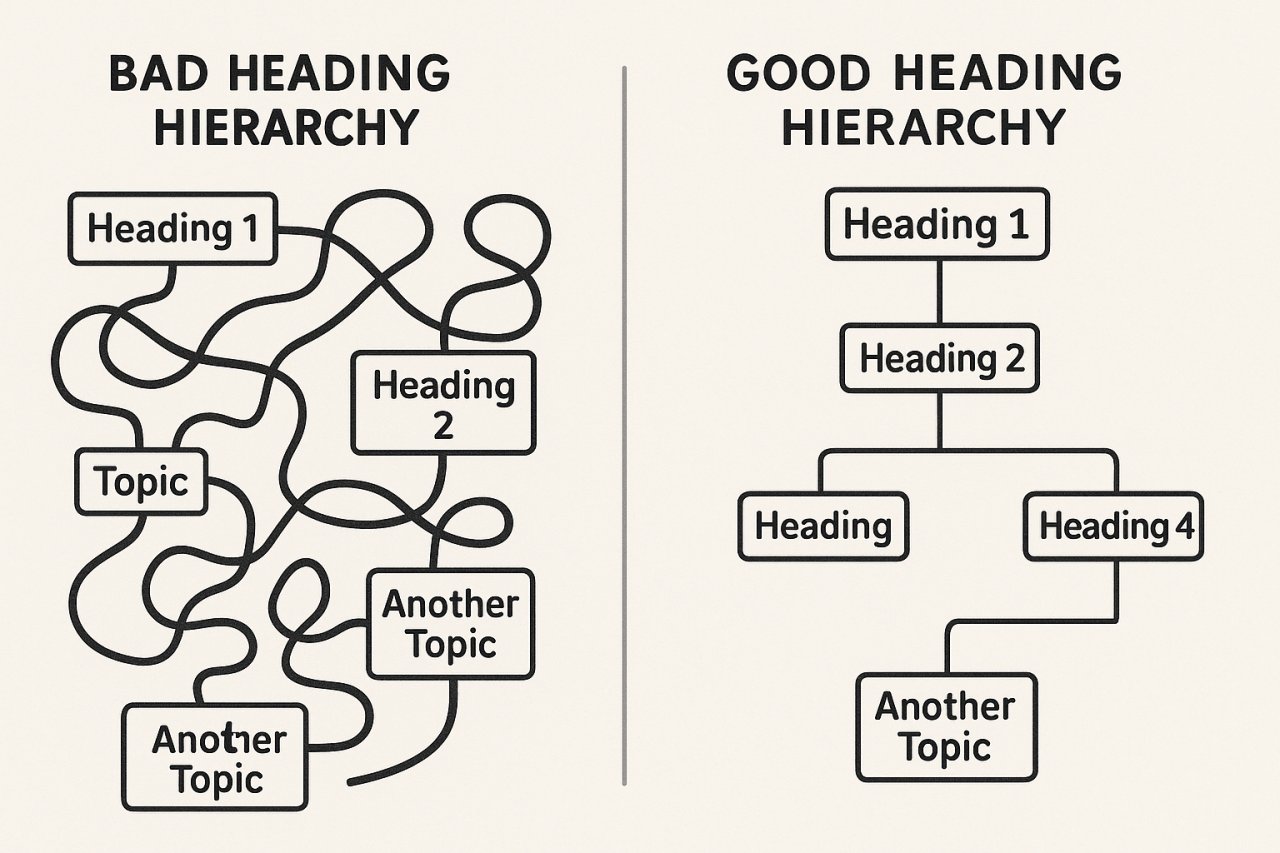
Going from H2 directly to H4 confuses both users and search engines. The heading structure should mirror an outline — if you can’t export your headings into a logical table of contents, your hierarchy is broken.
Most WordPress themes let you style headings however you want visually. Use that flexibility for design, but maintain semantic HTML hierarchy for SEO. Screen readers, crawlers, and accessibility tools all rely on proper heading order.
Semantic SEO: Stop Optimizing for Keywords, Start Optimizing for Topics
Google doesn’t rank pages for keywords anymore — it ranks them for topical coverage. When you publish a 2,500-word guide on “content marketing strategy,” the algorithm expects to see related concepts: buyer personas, content calendars, distribution channels, performance metrics.
If those terms are missing, Google assumes your coverage is shallow, even if your word count is high. Conversely, a well-structured 1,500-word piece that systematically covers the topic’s semantic landscape will outrank a rambling 3,000-word post that repeats the same points.
Use Entities, Not Just Keywords
Entities are people, places, things, and concepts that Google’s Knowledge Graph recognizes. In a post about “email marketing automation,” entities might include: Mailchimp, HubSpot, drip campaigns, segmentation, open rates, A/B testing.
Mention these naturally in context. You don’t need to hit a specific density — just prove you understand the conceptual ecosystem around your topic. One genuine paragraph comparing automation platforms beats ten keyword-stuffed sentences.
Internal Linking Architecture Transforms Content into Authority
This is where most long-form content strategies collapse. You publish brilliant 3,000-word guides, but they exist as isolated islands. No internal links in, no links out. Google sees them as disconnected pages, not parts of a larger expertise narrative.
Internal linking for long-form content isn’t about randomly linking related posts. It’s about deliberately constructing a topical authority architecture — a network where pillar pages connect to cluster content, where supporting articles point back to comprehensive guides, and where every link reinforces a semantic relationship.
Build Content Hubs, Not Random Blog Archives
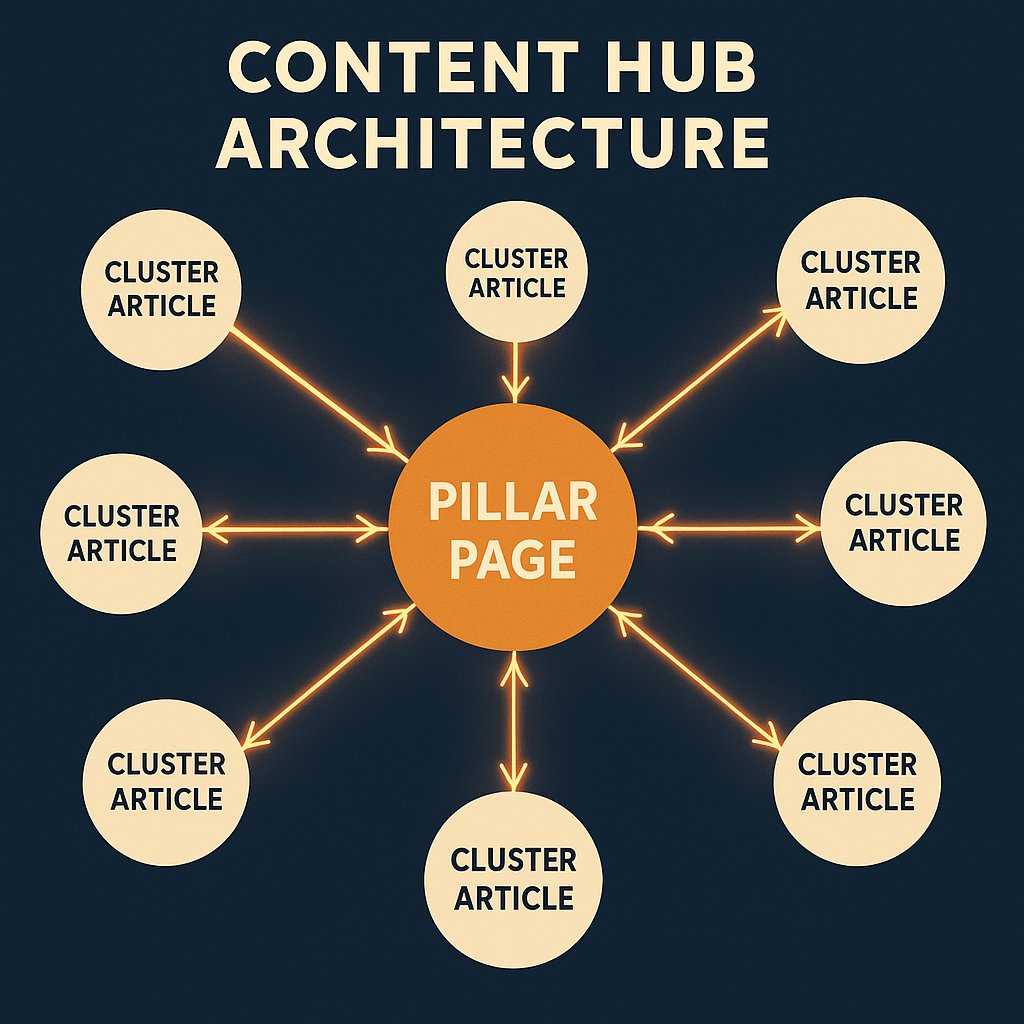
A content hub is a pillar page surrounded by 8-12 supporting articles, all interlinked. The pillar covers a broad topic at 3,000+ words. Each cluster article dives deep into one subtopic at 1,500-2,000 words. Internal links connect them bidirectionally.
Example: Your pillar is “Complete Guide to SEO for SaaS.” Cluster articles might include “Technical SEO for SaaS Platforms,” “Content Strategy for SaaS Blogs,” “Link Building for B2B SaaS,” and “Conversion Rate Optimization for SaaS Landing Pages.”
Every cluster article links back to the pillar in the intro. The pillar links out to each cluster piece in relevant sections. This structure tells Google: we own this topic.
Contextual Anchors Beat Generic “Click Here” Links
Your anchor text should describe what the linked page is about, not that it exists. “Learn more about keyword research” is weak. “Our keyword clustering methodology” is specific and valuable.
For long-form content, place internal links within the flow of an argument, not at the end as a list of related posts. If you’re explaining content distribution and mention email sequences, link the phrase “email sequences” to your guide on that topic. Readers click contextual links 3-4x more than “further reading” boxes.
Automate Internal Linking to Scale Topical Authority
Manually managing internal links across 50+ long-form articles is unsustainable. Every time you publish a new piece, you should theoretically go back and add relevant links from older posts. Almost no one does this consistently.
Tools like AI Internal Links solve this by analyzing your content semantically and automatically suggesting relevant internal links based on topical relationships. Instead of spending hours mapping links manually, you get AI-driven recommendations that strengthen your site’s authority structure as your content library grows.
Image Optimization for Long-Form Content Isn’t Optional
Every image in a long-form article is an opportunity to rank in image search and reinforce your topic. Alt text isn’t just for accessibility — it’s a semantic signal.
Descriptive alt text: “content hub structure showing pillar page connected to 8 cluster articles with bidirectional internal links”
Bad alt text: “diagram”
The first version helps Google understand the image’s context within your article and gives you a chance to rank for image queries related to content hub architecture.
Use Images to Break Up Dense Sections
After 4-5 paragraphs of text, insert a relevant image, screenshot, or diagram. Not as decoration, but as visual reinforcement of the concept you just explained. Charts, annotated screenshots, and flowcharts turn abstract SEO advice into concrete examples readers can remember.
Compress images without losing quality. A 3,000-word post with twelve 2MB images will load in 8 seconds on mobile. That tanks your Core Web Vitals score and kills rankings, no matter how good your content is.
Optimize for UX Signals Google Actually Measures
Dwell time, scroll depth, and return-to-SERP rate aren’t direct ranking factors, but they correlate strongly with rankings because they signal content satisfaction. Long-form content naturally scores better on these metrics — if it’s well-structured.
Add a table of contents at the top with jump links to H2 sections. Readers who see a 3,000-word post want to know they can navigate it. A TOC reduces perceived effort and increases scroll depth because users feel in control.
End with a Summary or Next-Step CTA
After 2,500 words, readers are mentally tired. Don’t just stop. Either summarize your key points in 3-4 bullets, or tell them exactly what to do next: “Now that you understand on-page SEO for long-form content, the next step is building a content hub around your highest-value topic.”
This reduces bounce rate by giving readers a clear resolution. They feel the article is complete, not abandoned.
Long-form content wins rankings when every on-page element — from heading hierarchy to internal link architecture — works together to prove topical authority. Length is your canvas, but structure is your strategy.
Most marketers stop optimizing after hitting publish. The real advantage comes from iterative refinement: adding internal links as you publish related content, updating semantic coverage when competitors add new angles, and watching how users interact with your structure. On-page SEO for long-form content isn’t a checklist — it’s an evolving system that compounds authority over time.