

Table of Contents
AI content tools promise speed. Write 10 blog posts in an afternoon. Scale your content output by 10x. Dominate search results through sheer volume. The pitch sounds compelling until you realize Google has spent years getting better at detecting thin, derivative content — and AI makes it easier than ever to produce exactly that.
Here’s what most content teams get wrong: they treat AI like a replacement writer instead of what it actually is — a research assistant that needs heavy editorial oversight. The sites winning with AI aren’t the ones publishing raw ChatGPT output. They’re the ones using AI to accelerate research and first drafts, then layering in expertise, original insights, and quality control that machines can’t replicate.
Let’s break down how to actually do this without tanking your rankings.
Why Most AI Content Fails SEO Quality Standards
Google’s algorithms have evolved specifically to catch the patterns AI tools leave behind. The 2024 Helpful Content Update targeted sites that prioritized search-first content over user-first content — and AI-generated articles are the poster child for that problem.
The Three Fatal Flaws of Unedited AI Content
Generic positioning kills credibility faster than anything else. AI models are trained on billions of web pages, which means they excel at producing the consensus view. Ask ChatGPT to explain link building and you’ll get a perfectly adequate explanation that sounds like every other SEO 101 article published in the last five years.
That’s not what ranks. What ranks is specificity, counterintuitive insights, and examples that could only come from someone who’s actually done the work.
Factual hallucinations remain a persistent problem. AI models don’t fact-check themselves — they predict what text should come next based on patterns. That means they’ll confidently cite studies that don’t exist, quote statistics they invented, and reference tools that were discontinued years ago.
You can’t outsource verification. Every claim needs manual checking.
Surface-level coverage is the third killer. AI excels at breadth but struggles with depth. It can write a 2,000-word article touching on 15 different subtopics, but it won’t go three levels deep on any single concept the way an expert would.
Google’s algorithms increasingly favor comprehensive treatment of specific topics over shallow coverage of broad ones. If your AI content reads like a Wikipedia summary, it won’t outrank competitors who actually explain the nuances.
What Google Actually Penalizes
Let’s clear up a misconception: Google doesn’t penalize AI content because it’s AI-generated. The March 2024 algorithm updates made this explicit. Google penalizes content that fails to meet quality standards, regardless of how it was produced.
The problem is that unedited AI output almost always fails those standards.
The specific signals Google uses to assess content quality include expertise signals (are you citing real experience?), originality signals (is this perspective unique?), and depth signals (do you actually answer the question comprehensively?).
AI out of the box scores poorly on all three.
The AI Content Workflow That Actually Works
The teams I’ve seen succeed with AI treat it as one component in a larger editorial system. Not the writer. Not the editor. The research assistant and first-draft generator.
Step One: Strategic Briefing
Most people fail at prompt engineering because they think it’s about clever phrasing. It’s not. It’s about giving the AI enough context and constraints that its output is 70% usable instead of 30% usable.
Your brief should include the specific angle you’re taking (not just the topic), the target audience and their sophistication level, the content gaps you’ve identified in competing articles, and three to five original insights or examples you plan to include.
Bad brief: “Write an article about technical SEO”
Good brief: “Write an article explaining why most WordPress sites have crawl budget issues even with proper XML sitemaps. Target audience: marketing managers running content sites with 1,000+ pages. Cover how poor internal link architecture wastes crawl budget on low-value pages. Include examples from e-commerce category structures and blog pagination.”
The second brief gives the AI guardrails. It knows what to focus on, what depth to aim for, and what audience to write for.
Step Two: Generate Framework, Not Final Copy
Use AI to create the structure and rough draft — the skeleton you’ll flesh out. Don’t expect it to write publication-ready paragraphs. Expect it to organize your thoughts and suggest angles you might not have considered.
I typically generate three different outlines with slightly different prompts, then combine the best elements of each. AI is cheap to run. There’s no reason to commit to the first output it gives you.
Step Three: Layer In Expertise
This is where the actual content quality emerges. Go through every major claim the AI made and ask yourself: Could I defend this statement to a skeptical expert?
If not, either cut it, qualify it, or back it up with something concrete — a case study, a specific tool recommendation, a counterexample that proves the nuance.
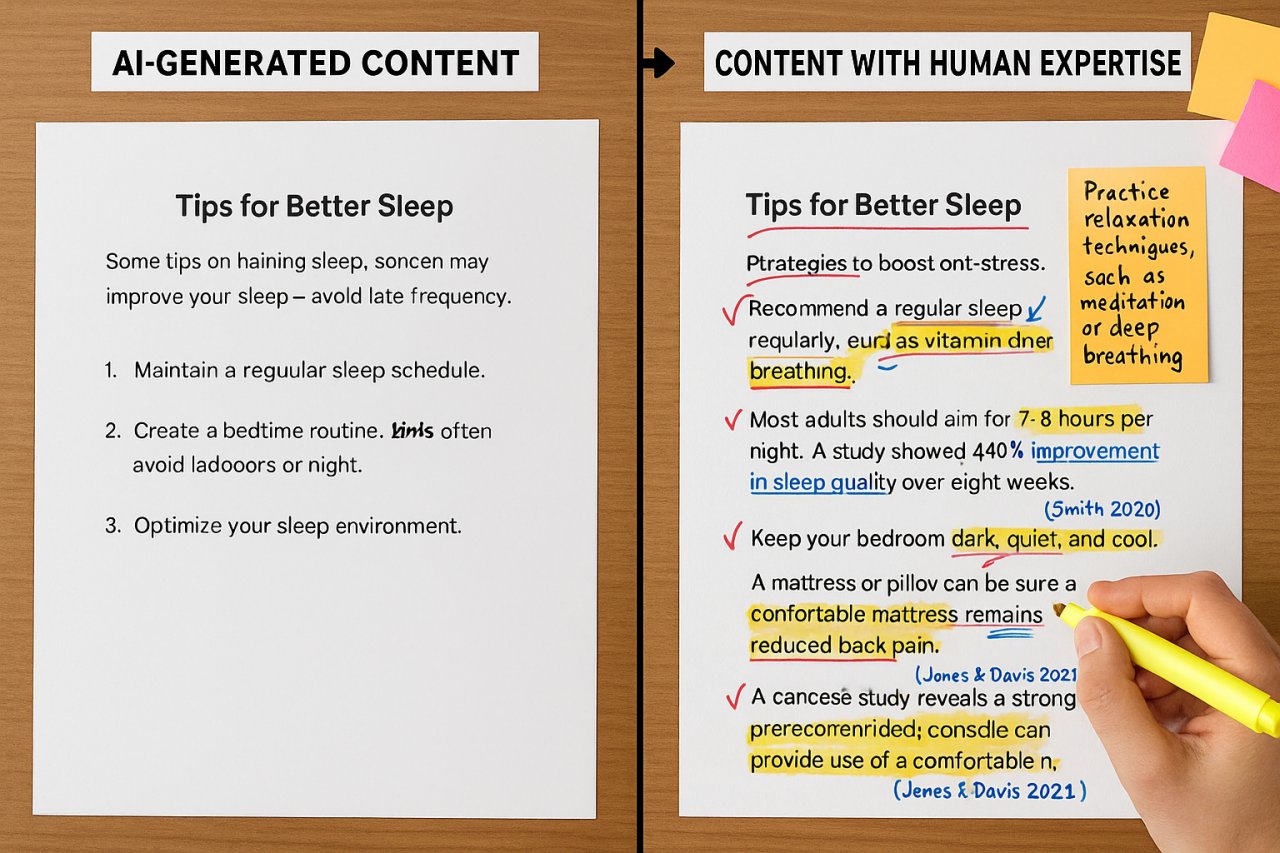
The expertise layer is also where you add the details AI can’t access. Your proprietary methodology. The mistake you made last year that taught you something valuable. The tool comparison you ran on 50 different sites to figure out which one actually performs better.
This is the content Google rewards. This is what separates you from the 100 other sites that asked ChatGPT to write about the same topic.
Step Four: Fact-Check Everything
Create a spreadsheet with every factual claim in your article. Every statistic. Every tool name. Every algorithm update date. Then verify each one.
This sounds tedious, but it’s faster than you think — and it’s non-negotiable. One confidently stated falsehood will destroy your credibility with readers who actually know the space.
Use primary sources whenever possible. Don’t cite “a study” — cite the specific research paper with a link. Don’t say “experts recommend” — quote a named practitioner and link to where they said it.
Maintaining Topical Authority at Scale
Here’s where AI content gets dangerous: it’s so easy to produce that teams publish 50 articles on loosely related topics instead of 10 articles that deeply explore a single domain.
Google’s algorithms are sophisticated enough to recognize topical authority. A site with 10 comprehensive articles about technical WordPress optimization will outrank a site with 100 shallow articles about “SEO tips.”
Building Content Clusters Properly
A content cluster is a pillar page covering a broad topic comprehensively, supported by 5-10 cluster pages that dive deep into specific subtopics. Each cluster page links back to the pillar, and the pillar links out to relevant clusters.
AI makes it tempting to generate 50 cluster pages in a weekend. Resist that urge.
Instead, start with a truly comprehensive pillar page — 3,000+ words that could serve as the definitive guide to your topic. Then add cluster content one piece at a time, only when you have something genuinely new or deeper to say about that subtopic.
Quality clusters beat quantity every time.
The Interlinking Requirement
As you scale AI content production, internal linking architecture becomes critical. Every new article needs to be connected to your existing content in a way that makes semantic sense.
This is where most teams fail. They publish 20 AI-generated articles in a month, then realize none of them link to each other in any meaningful way. Google sees a collection of isolated pages, not a comprehensive resource.
You need a system for this. Either someone manually reviews each piece to add contextually relevant internal links, or you use automation tools designed for this specific problem. The worst outcome is publishing interconnected content that stays siloed.
Topical Authority Signals Google Actually Measures
Google evaluates topical authority through several signals: semantic clustering (are your articles related to each other?), entity coverage (do you mention and explain the key concepts in your niche?), depth over breadth (do you explain things comprehensively, or just touch the surface?), and content freshness (do you update your existing content, or just add new pages?).
AI-generated content often fails the depth test. It’s easy to spin up 50 articles on different subtopics. It’s hard to write one article that actually teaches something new.
Focus on the hard thing.
E-E-A-T Compliance with AI-Generated Content
Google’s E-E-A-T framework (Experience, Expertise, Authoritativeness, Trustworthiness) was designed specifically to combat low-quality content at scale. If you’re using AI, you need to manually inject these signals.
The Experience Problem
AI models have no experience. They’ve never run an SEO audit, optimized a page, or watched a ranking recover after fixing technical issues.
You have. That’s your competitive advantage.
Every AI-generated article should include at least one section based on your direct experience. A case study. A mistake you made. A counterintuitive result from testing. The insight that only comes from doing the work.
This doesn’t need to be a formal case study with charts and data. It can be as simple as: “Last year I worked with an e-commerce site that had 10,000 products but only 200 indexed pages. Turns out their pagination setup was blocking category pages past page 3. Fixing that doubled their organic traffic in six weeks.”
Concrete. Specific. Unpredictable.
Author Credibility Signals
Google pays attention to author bylines now. A post written by “Admin” or “Editorial Team” carries less weight than one written by a named practitioner with a track record.
If you’re publishing AI-assisted content, attach it to a real author with:
- A complete author bio with credentials and experience
- Social profiles and professional affiliations
- A history of published work in the niche
- Links to other sites where they’ve been cited or quoted
This signals to Google that a knowledgeable human reviewed and approved this content — even if AI helped produce the first draft.
Citation and Source Quality
AI loves to make vague references: “Studies show…” or “Experts recommend…” These phrases are red flags for AI-generated content because they avoid specificity.
Every claim needs a named source. If you mention a study, link to it. If you reference expert opinion, cite who said it and where. If you discuss an industry trend, point to the data.
This serves two purposes: it makes your content more credible to readers, and it sends trust signals to Google’s algorithms.
Quality Control Systems for AI Content at Scale
Once you’re producing more than a few articles per week, you need systematic quality control. You can’t rely on one editor reading everything carefully.
The Three-Pass Editing Framework
Pass one is the expertise review. Does this article contain original insights? Could it have been written by someone who doesn’t actually work in this field? If the answer is yes, send it back for revision.
Pass two is the fact-check. Verify every statistic, every tool name, every algorithm date. Check that links go where they’re supposed to. Confirm that screenshots are current.
Pass three is the readability pass. Read it out loud. Does it sound like a human wrote it, or does it sound like a content mill? Cut anything that feels like filler. Tighten loose paragraphs. Add personality where it’s missing.
Only after all three passes does content get published.
Using AI to Check AI Content
Here’s an irony: AI tools can help identify problems in AI-generated content. Run your draft through a tool like Grammarly or Hemingway App. Check reading level. Look for repeated phrases or sentence structures.
You can also prompt a second AI model to critique the first one’s output. Ask: “What factual claims in this article need verification?” or “What sections feel generic or surface-level?” The results aren’t perfect, but they catch obvious problems.
Long-Term Strategy: Building Assets, Not Content Mills
The sites that succeed with AI content are the ones treating articles as long-term assets, not disposable traffic plays. That means different incentives and different workflows.
Update Velocity Matters More Than Publish Velocity
Publishing 20 new articles per month looks impressive. But if those articles are never updated, their value decays rapidly — especially in fast-moving fields like SEO.
Better strategy: publish 10 new articles and update 10 existing ones. Keep your best content current. Add new examples. Revise sections that are no longer accurate. Google rewards freshness, especially when it’s substantive.
Metrics That Actually Matter
Stop tracking “articles published per week” as your primary KPI. It incentivizes volume over value.
Track these instead:
- Organic traffic per article (which pieces actually drive results?)
- Average time on page (are people reading, or bouncing?)
- Keyword rankings for target terms (is the content actually ranking?)
- Backlinks earned per article (is the content good enough to cite?)
- Conversion rate from organic traffic (does the audience actually care?)
These metrics tell you whether your content is working. Publishing 100 articles that get zero traffic is worse than publishing 10 that each drive consistent visitors.
The Compound Value of Quality
Here’s what happens when you prioritize quality over quantity: your best articles start earning backlinks. Other sites cite you. Your domain authority grows. That makes every future article you publish rank faster and higher.
The compound effect is real. A site with 50 genuinely excellent articles will outperform a site with 500 mediocre ones — not just in rankings, but in business results.
AI gives you leverage to produce content faster. Use that leverage to make fewer, better things.
The teams winning right now aren’t the ones using AI to scale to 100 articles per month. They’re the ones using AI to produce 20 articles at the quality level that used to take them two months. That’s the edge.
Speed without quality is noise. Speed with quality is a competitive advantage.