
Table of Contents
- Why Most WordPress Sites Fail at On-Page SEO Scale
- The Four-Layer On-Page Optimization Framework
- The Internal Linking Problem at Scale
- Entity Optimization: The Advanced Move
- Automating the Bottleneck: Internal Linking at Scale
- Execution: The 90-Day On-Page Optimization Sprint
- What Most People Get Wrong About SEO at Scale
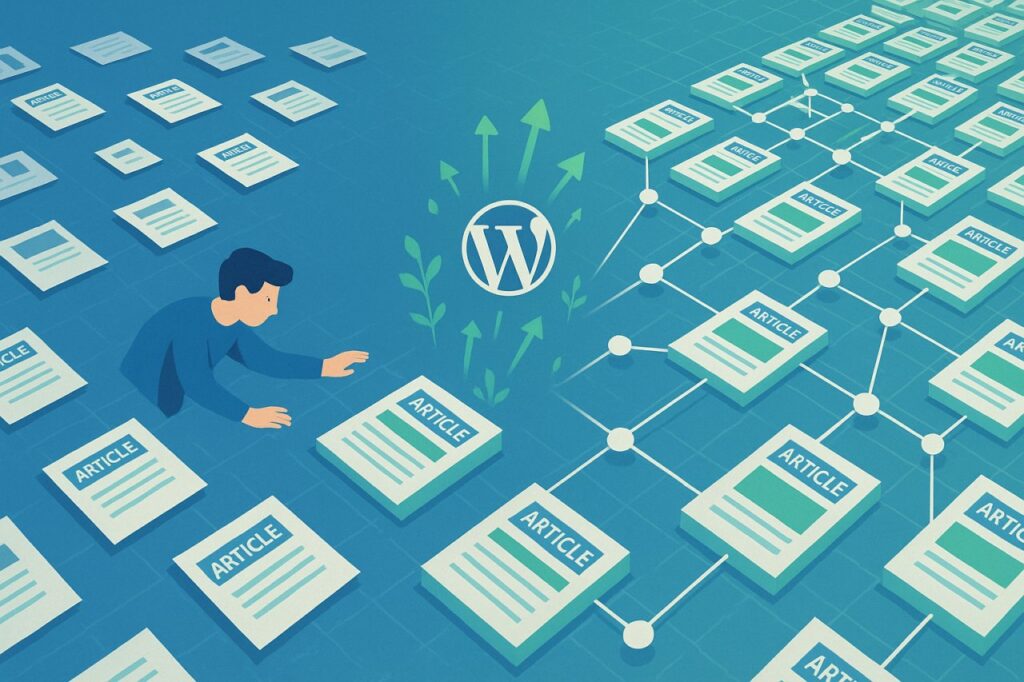
If you’ve got more than 50 articles, manual optimization becomes the bottleneck. You’re either burning hours tweaking old posts one by one, or you’re ignoring them entirely while pumping out new content. Neither works.
Here’s the framework that does.
Why Most WordPress Sites Fail at On-Page SEO Scale
Small sites can get away with treating every article like a bespoke piece. You research the keyword, craft the perfect title, optimize every heading, manually link to three related posts. It works when you’ve got 20 articles.
But when you hit 100+ posts, that approach collapses. The math doesn’t work. Even at 30 minutes per article, optimizing 200 posts takes 100 hours. That’s 12 full workdays.
And that’s assuming you remember what you wrote three months ago.
The Hidden Cost: Context Loss
The real killer isn’t time — it’s context fragmentation. You wrote an article about WordPress security in January. In March, you published one about site speed. In May, about schema markup. Each one exists in isolation because you literally forgot the others existed when you wrote the new one.
Google notices. Your site has no topical coherence. Pages don’t reinforce each other. Authority gets diluted instead of concentrated.
This is why content hubs exist in theory but fail in practice.
The Four-Layer On-Page Optimization Framework
Forget trying to optimize everything everywhere all at once. Break it into layers you can actually execute.
Layer 1: Keyword Mapping (The Foundation Nobody Does Right)
Most sites assign keywords to posts randomly. Someone writes about WordPress caching, picks a keyword, ships it. Next week, someone else writes about site speed and targets a 90% overlapping term.
Now you’re competing with yourself.
Start with an inventory. Export every post URL, title, and primary keyword into a spreadsheet. Group them by topic cluster: security, performance, SEO, content strategy. Look for cannibalization — multiple posts targeting the same intent.
You’ll find it. Everyone does.
Layer 2: Content Refresh (High-ROI, Low-Effort Wins)
Don’t refresh everything. That’s the trap. Refresh posts that already rank on page 2 or 3. These are low-hanging fruit — they have authority, they just need a push.
Search Console shows you exactly which ones. Filter for queries ranking positions 11-30 with >100 impressions per month. Those are your targets.
For each post:
- Update the publish date (yes, Google notices)
- Expand thin sections — if a section is two paragraphs, make it four
- Add a comparison table or FAQ schema where relevant
- Fix any H2s that read like filler
You’re not rewriting from scratch. You’re taking a 6/10 post to an 8/10.

Layer 3: Structural Optimization (The Part Most People Skip)
On-page SEO isn’t just keywords. It’s information architecture.
Every article needs a clear content structure:
- One H1 (your title — WordPress does this automatically)
- H2s that divide the article into major sections
- H3s that break down each section into digestible chunks
- Short paragraphs (3-4 lines max on desktop)
Read through your top 20 posts. If any paragraph runs longer than five sentences, break it. If an H2 section has no H3s beneath it, add them. If your headings are generic ("Introduction," "Benefits," "Conclusion"), rewrite them to include keywords naturally.
Example: Change "Why This Matters" to "Why Internal Linking Affects Your WordPress Rankings."
The Internal Linking Problem at Scale
Here’s where manual optimization breaks completely.
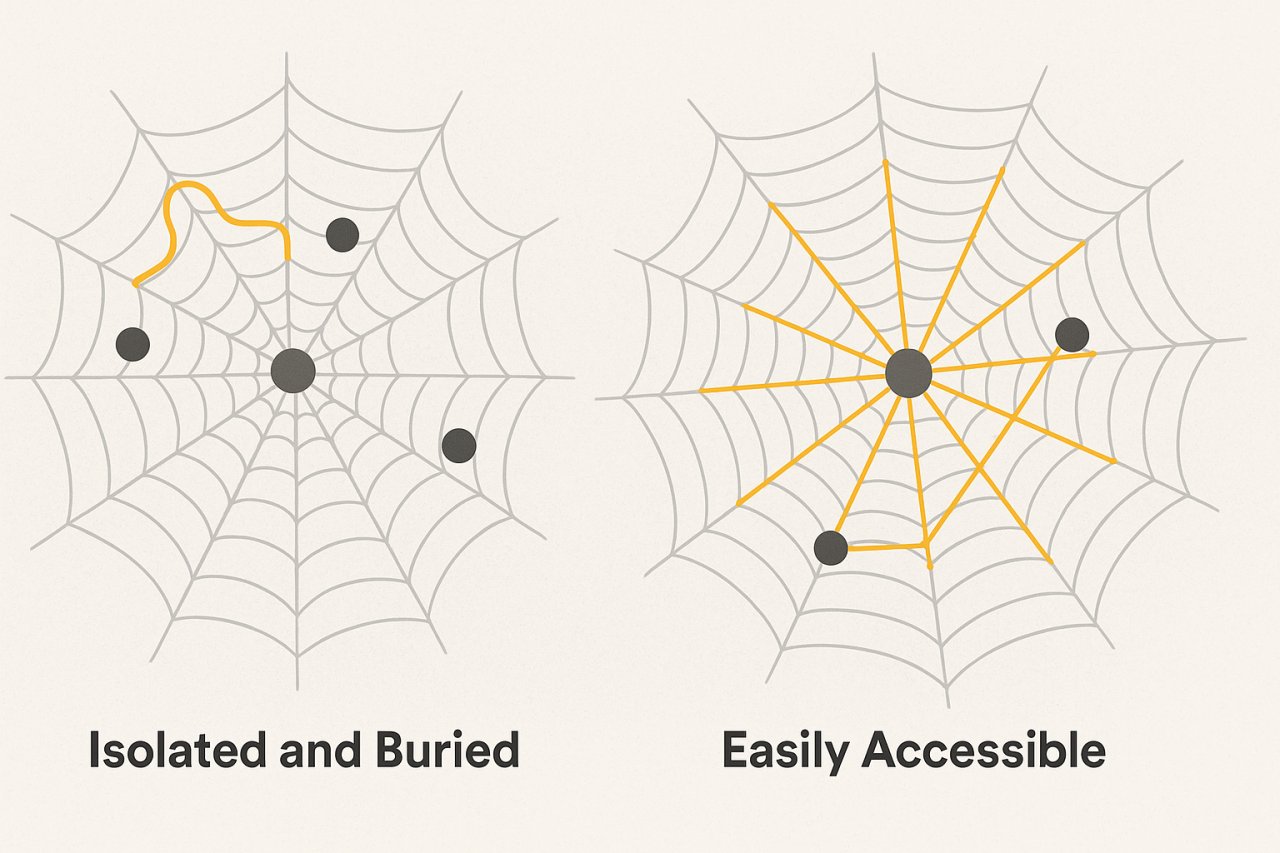
With 10 articles, you can remember which ones are related. With 100, you can’t. You’ll link to the same five popular posts over and over because they’re top of mind. Meanwhile, 60% of your content becomes orphan pages — published but not linked to from anywhere.
Google’s crawler finds them through your sitemap, crawls them once, then never comes back. They rank nowhere.
This isn’t a content quality problem. It’s a distribution problem.
Why Manual Linking Doesn’t Scale
Let’s say you commit to adding three internal links to every new post. That’s achievable. But what about your existing 200 posts?
They’re frozen in time. The links you added in 2022 still point to the same posts. New content you publish in 2024 never gets linked from those old articles unless you manually go back and update them.
You won’t. Nobody does. The result: your newest, freshest content gets ignored by your own site architecture.
The Crawl Budget Multiplier Effect
When internal linking is inconsistent, Google’s crawler wastes budget. It hits your homepage, follows a few links, finds some of your content, then leaves. Pages buried four clicks deep might get crawled once a month.
Strong internal linking creates a crawl highway. Every page is within two clicks of your homepage. New content gets discovered within hours, not weeks.
This compounds. Faster crawling means faster indexing means faster ranking.
Entity Optimization: The Advanced Move
Google doesn’t just match keywords anymore. It understands entities — people, places, concepts, brands.
If you write about WordPress security, your article should mention related entities: SSL certificates, firewalls, Wordfence, Sucuri, two-factor authentication. Not because you’re keyword stuffing, but because these entities exist in the same semantic space.
How to apply this:
Step 1: Identify Core Entities in Your Niche
For a WordPress SEO blog, core entities might include: Yoast, Rank Math, Google Search Console, schema markup, canonical URLs, crawl budget, topical authority.
Make a list. Keep it under 50 terms.
Step 2: Audit Entity Coverage
Do your articles mention these entities naturally? Or are they focused narrowly on a single keyword?
If you wrote about "WordPress SEO plugins" but never mentioned Rank Math or All in One SEO, you’re missing semantic signals.
Step 3: Weave Them In (But Don’t Force It)
Entity optimization isn’t about stuffing every post with brand names. It’s about demonstrating topical depth. If you’re explaining crawl budget, mentioning sitemaps and internal linking architecture is natural. If you’re not, you’re probably writing too narrowly.
Automating the Bottleneck: Internal Linking at Scale
The framework so far is manual but manageable — keyword mapping, selective content refresh, structural cleanup, entity enrichment. You can execute all of that in sprints.
But internal linking? That’s the one layer that fights you every step.
This is where automation stops being a nice-to-have and becomes the only viable path forward. Tools like AI Internal Links analyze your entire content library, understand semantic relationships between posts, and inject contextual links automatically.
It’s not about laziness. It’s about solving a problem that doesn’t scale manually. When you publish a new post, the plugin backfills links from existing articles. When you update an old post, it finds new linking opportunities based on your current content.
Your internal link graph stays dynamic instead of decaying.
The Compound Effect of Automated Linking
Manual linking creates static connections. Automated linking creates a living architecture.
Every time you publish, your older posts get smarter about what to link to. Every time you update, the system recalculates optimal anchor text. You’re not managing 200 posts. You’re managing one interconnected system that optimizes itself.
That’s the difference between a blog and a content hub.
Execution: The 90-Day On-Page Optimization Sprint
Here’s how to implement this framework without burning out.
Month 1: Audit and Map
- Export all posts into a spreadsheet
- Assign primary keywords and topic clusters
- Identify cannibalization and orphan pages
- Tag posts by freshness: current, needs refresh, outdated
Month 2: Optimize the Top 20%
- Focus on posts ranking positions 11-30
- Refresh content, improve structure, add schema
- Fix heading hierarchy and break up long paragraphs
- Set up automated internal linking
Month 3: Scale and Monitor
- Refresh the next batch based on Search Console data
- Monitor ranking improvements
- Adjust keyword mapping as needed
- Let automated linking handle new posts
You’re not trying to fix everything at once. You’re building a system that improves itself over time.
What Most People Get Wrong About SEO at Scale
They think it’s about doing more.
It’s actually about doing less, better. The goal isn’t to optimize 200 posts in a week. It’s to create a self-reinforcing system where each optimization compounds the value of the others.
Keyword mapping ensures you’re not competing with yourself. Content refresh focuses effort on high-ROI pages. Structural optimization makes every post easier to crawl and rank. Entity enrichment builds topical authority. Automated internal linking ties it all together.
Skip any one layer and the others lose effectiveness.
Start with the inventory. Fix the structure. Let automation handle the links. Watch what happens when your content library starts working as a system instead of a pile of isolated posts.