

Why Topic Clusters Transform WordPress SEO Performance
Search engines have evolved far beyond keyword matching. Google’s algorithms now understand context, semantic relationships, and topical authority. For WordPress site owners, this shift demands a strategic approach to content organization—one that moves away from isolated blog posts toward interconnected content ecosystems.
Topic clusters represent this evolution in action. Rather than creating standalone articles hoping each will rank, you build comprehensive content hubs that demonstrate expertise across entire subjects. This approach signals to search engines that your site is an authoritative resource, not just a collection of random articles.
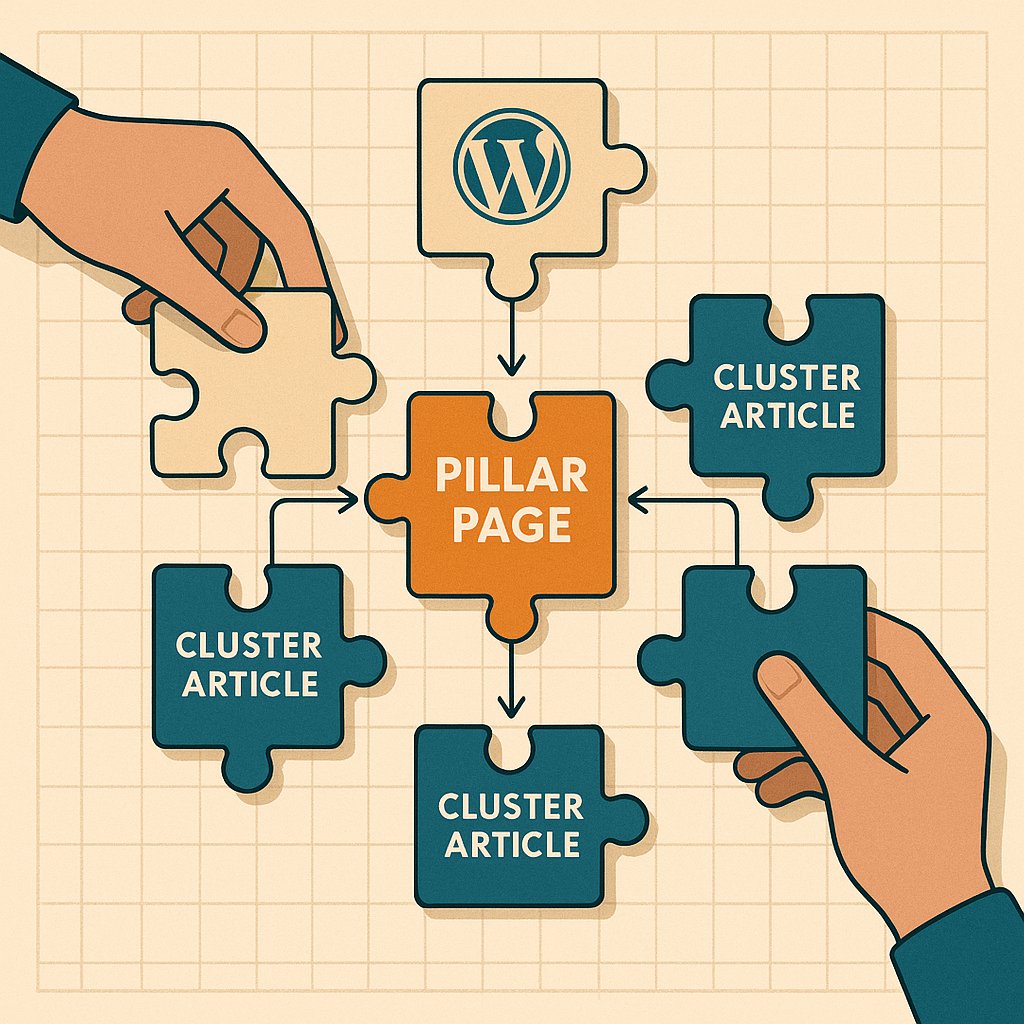
The pillar-cluster model reshapes how visitors and search crawlers navigate your WordPress site. A single pillar page serves as the authoritative guide to a broad topic, while cluster content dives deep into specific subtopics. Strategic internal links bind these elements together, creating pathways that distribute authority and guide users through their journey.
WordPress sites implementing topic clusters typically see improvements in multiple SEO metrics simultaneously. Pages rank for broader keyword sets, dwell time increases as visitors explore related content, and crawl efficiency improves as search engines follow clear topical pathways. The architecture itself becomes a ranking factor.
Understanding the Pillar-Cluster Architecture
What Makes a Pillar Page Effective
Pillar pages differ fundamentally from traditional long-form content. These comprehensive guides cover a broad topic at a strategic depth—detailed enough to be valuable, but designed to link out to specialized cluster content for deeper exploration.
An effective pillar page typically spans 3000-5000 words, addressing the topic’s key dimensions without exhausting every detail. The structure prioritizes scanability with clear sections that correspond to cluster subtopics. Each section provides enough value to stand alone while naturally inviting readers to explore related cluster articles.
The pillar page serves multiple audiences simultaneously. Newcomers get a complete overview of the topic. Experienced visitors find quick navigation to advanced subtopics. Search engines discover a clear content hierarchy that maps topical relationships.
Cluster Content Characteristics
Cluster articles focus narrowly on specific aspects introduced in the pillar page. While pillar pages provide breadth, clusters provide depth. A cluster article might explore one tactic, address one common question, or solve one specific problem within the broader topic.
Quality cluster content maintains 1000-2500 words—substantial enough for ranking potential, focused enough to avoid topic drift. Each cluster article stands as a complete resource while remaining clearly connected to its pillar page through strategic internal linking.
The cluster relationship isn’t just hierarchical. Cluster articles can link horizontally to related clusters when topics naturally intersect, creating a rich web of topical connections that enhance user experience and SEO value.
The Internal Linking Framework
Internal links form the connective tissue of topic clusters. The linking pattern follows specific principles that maximize both user experience and SEO impact.
Every cluster article must link back to its pillar page using descriptive anchor text that includes relevant keywords. The pillar page links out to all cluster articles, typically from relevant sections where each subtopic is introduced. This bidirectional linking establishes clear hierarchical relationships.
Horizontal links between related cluster articles create additional pathways for visitors exploring specific aspects of the topic. These connections help users discover content they didn’t know existed while distributing link equity throughout the cluster.
Planning Your WordPress Topic Cluster Strategy
Identifying High-Value Topics
Not every subject warrants cluster treatment. The best topics for cluster architecture have sufficient breadth to support multiple subtopics while remaining focused enough to maintain topical coherence.
Start by analyzing your existing content performance. Which topics already drive traffic? Which keywords have search volume but incomplete coverage on your site? Where do competitors dominate with comprehensive content that you could match or exceed?
Consider your audience’s journey through your topic. What questions do they ask first? What advanced concepts do they need to understand later? A well-planned cluster mirrors this progression from foundational to specialized knowledge.
Mapping Cluster Relationships
Visualization transforms abstract cluster concepts into actionable content plans. Creating a topic map reveals gaps, redundancies, and optimal linking opportunities before you write a single word.
Your topic map should position the pillar page at the center with cluster topics radiating outward. Group related clusters together to identify potential horizontal linking opportunities. Look for natural progressions where one cluster logically leads to another.
This mapping process often reveals content you already have that fits cluster architecture. Existing articles might need updates and better internal linking rather than complete rewrites. New cluster articles should fill gaps where visitor questions remain unanswered.
Keyword Research for Clusters
Keyword strategy differs between pillar and cluster content. Pillar pages target broad, high-volume keywords that encompass the entire topic. Cluster articles pursue specific long-tail keywords that address focused aspects of the subject.
For pillar pages, focus on keywords that people search when first exploring a topic. These often have significant search volume and moderate to high difficulty. The pillar’s comprehensive nature and strong internal link support helps compete for these competitive terms.
Cluster keywords target specific questions, problems, or subtopics. These long-tail keywords typically have lower search volume individually but collectively represent substantial traffic potential. The specificity also means higher conversion rates as visitors find exactly what they need.
Implementing Topic Clusters on WordPress
Creating Your Pillar Page Foundation
Pillar page development requires intentional structure that supports both readers and search engines. Begin with a comprehensive outline that covers all major aspects of your topic, ensuring each section corresponds to potential cluster articles.
Your pillar page introduction should establish the topic’s importance and outline what the guide covers. Use a table of contents that links to sections within the page—this improves user experience and creates additional internal linking opportunities that search engines value.
Each section within the pillar page should provide sufficient value independently while explicitly mentioning that deeper coverage exists in dedicated cluster articles. This creates natural opportunities for internal links using descriptive anchor text.
Developing Cluster Content
Cluster articles require balance between depth and focus. Go deep on your specific subtopic without drifting into tangential subjects that belong in other clusters.
Structure each cluster article to stand alone as a complete resource. Visitors might land directly on cluster pages from search results rather than navigating from the pillar. Provide enough context that they understand the broader topic while focusing on your specific angle.
Include multiple internal links back to the pillar page throughout the cluster article. The introduction often works well for this link, but also include contextual links where specific pillar page sections are relevant to points you’re making.
Optimizing Internal Link Architecture
Internal linking within topic clusters follows specific best practices that maximize SEO value. Anchor text should be descriptive and keyword-rich without appearing manipulative or over-optimized.
Vary your anchor text when linking to pillar pages from multiple clusters. While some repetition is natural, using diverse phrases that all relate to the core topic signals broader relevance to search engines.
Consider link placement within content. Links within the first several paragraphs receive more weight than those buried at the bottom. Position your most important cluster-to-pillar links where they provide immediate value to readers.
WordPress Category and Tag Strategy
WordPress’s native organization features can reinforce your topic cluster architecture when used strategically. Creating dedicated categories for major topic clusters helps both site organization and SEO.
Assign all cluster articles and the pillar page to the same category. This creates automatic archive pages that showcase your topical coverage while generating additional internal linking opportunities through category navigation.
Use tags sparingly to highlight connections between clusters or mark content types rather than topics. Over-tagging dilutes focus and creates thin archive pages that add no value for visitors or search engines.
Scaling Topic Clusters Across Your WordPress Site
Managing Multiple Cluster Systems
As your content library grows, you’ll develop multiple topic clusters covering different aspects of your niche. Managing these interconnected systems requires organization and strategic oversight.
Maintain a content inventory that tracks which articles belong to which clusters. Spreadsheets work well for this purpose, documenting pillar pages, associated clusters, and key internal links. This overview prevents orphaned content and reveals opportunities for new clusters.
Different clusters will inevitably overlap at certain points. These intersections create valuable opportunities for cross-cluster internal linking that demonstrates your site’s comprehensive coverage of related topics.
Updating Existing Content Into Clusters
Most WordPress sites have existing content that can be reorganized into topic clusters without complete rewrites. This transformation starts with auditing your current articles to identify natural groupings.
Look for articles covering related aspects of the same broad topic. These become cluster candidates. Identify which existing article could serve as a pillar with expansion, or determine if you need to create a new pillar page from scratch.
Update cluster candidates by adding internal links to the pillar page and related clusters. Refresh content to ensure consistency in depth and quality across the cluster. This updating process often improves rankings for existing articles while strengthening the entire cluster’s performance.
Content Gap Analysis
Even well-developed clusters typically have gaps—subtopics that deserve dedicated articles but haven’t been created yet. Systematic gap analysis reveals these opportunities.
Review search queries that bring visitors to your cluster pages. Tools like Google Search Console show what people search before landing on your content. Queries that don’t match well with existing articles indicate gap opportunities.
Analyze questions and concerns raised in comments on your cluster articles. These represent real audience needs that new cluster content could address. Similarly, review related searches and people also ask boxes in Google results for cluster topics.
Automation and Efficiency Tools
Managing internal links across multiple topic clusters becomes increasingly complex as your WordPress site grows. Manual linking between dozens or hundreds of articles proves time-consuming and prone to missed opportunities.
Modern automation approaches can identify linking opportunities based on semantic relationships between content. Rather than relying on simple keyword matching, advanced tools analyze meaning and context to suggest relevant internal links. Solutions like AI Internal Links can automate this process while maintaining the strategic linking patterns that topic clusters require.
Automation proves particularly valuable when adding new cluster articles to existing topic systems. Rather than manually reviewing all related content to insert links, automated tools can suggest optimal placements that strengthen the cluster architecture.
Measuring Topic Cluster Performance
Key Metrics for Cluster Success
Topic cluster effectiveness manifests in multiple metrics that collectively indicate improved topical authority and user engagement.
Organic traffic growth to cluster content typically outpaces standalone articles. Monitor search impressions and clicks for cluster articles collectively. Improved rankings for both the pillar page and cluster articles indicate Google recognizes your topical authority.
Engagement metrics reveal how well your internal linking guides visitors through cluster content. Track pages per session for visitors who enter through cluster articles. Higher page counts suggest effective internal linking that encourages exploration.
Tracking Internal Link Performance
While external backlinks receive most attention, internal link performance within clusters deserves monitoring. Understanding which cluster articles receive the most internal link clicks reveals content that effectively serves as a hub within your topic architecture.
Google Analytics and similar tools track internal link clicks when properly configured. Review which cluster articles generate the most click-throughs to related content. High performers often become candidates for expansion into their own subclusters.
Conversion tracking becomes particularly important for commercial topics. Monitor which paths through your topic cluster lead to conversions. This intelligence helps optimize internal linking to guide visitors toward your most valuable content.
Iterating Based on Performance Data
Topic clusters require ongoing refinement based on performance data. Unlike static content strategies, cluster architecture should evolve as you learn what resonates with your audience and search engines.
Regularly audit internal links within clusters. Remove links that generate few clicks while adding links where natural opportunities emerge in updated content. This ongoing optimization keeps cluster architecture aligned with user behavior.
Expand high-performing clusters with additional subtopic articles. When a cluster article ranks well and drives significant traffic, consider creating related cluster articles that dive deeper into specific aspects it covers broadly.
Advanced Topic Cluster Strategies
Subclusters and Nested Architecture
Large topics benefit from nested cluster architecture where successful cluster articles become mini-pillar pages with their own subclusters. This approach scales topical coverage while maintaining organization.
A subcluster treats a specific cluster article as a pillar page for even more focused subtopics. The original pillar page links to the cluster article, which now links to its own subcluster articles, creating a three-tier structure.
This nested approach proves particularly valuable for complex topics in fields like healthcare, finance, or technology where individual subtopics warrant comprehensive coverage. The architecture remains navigable while demonstrating extraordinary depth.
Cross-Cluster Linking Strategies
While individual clusters focus on specific topics, strategic links between clusters demonstrate comprehensive expertise across related subjects. These cross-cluster connections require thoughtful implementation to avoid diluting topical focus.
Identify genuine intersections where one cluster’s subtopic naturally relates to another cluster’s content. These connections provide value to readers exploring related topics while signaling to search engines that your site covers adjacent subject areas comprehensively.
Limit cross-cluster links to truly relevant connections. Excessive linking between unrelated clusters dilutes topical authority and creates confusing navigation. Quality trumps quantity in cross-cluster architecture.
Using Schema Markup for Clusters
Structured data helps search engines understand your topic cluster relationships explicitly. While internal links provide implicit structure, schema markup makes these connections machine-readable.
Article schema can include relatedLink properties that point to cluster articles from pillar pages. Breadcrumb schema reinforces hierarchical relationships. FAQ schema on pillar pages can link directly to cluster articles that answer specific questions.
Implementing schema consistently across cluster content requires technical knowledge or WordPress plugins that simplify the process. The investment pays dividends as search engines better understand your content architecture.
Content Refresh Schedules
Topic clusters require maintenance to remain effective. Search algorithms evolve, competitors publish new content, and user needs change. Establishing refresh schedules keeps clusters competitive.
Pillar pages warrant quarterly reviews at minimum. Update statistics, add new sections for emerging subtopics, and refresh links to recently published cluster articles. These updates signal ongoing relevance to search engines.
Cluster articles need annual reviews unless they cover rapidly changing topics that require more frequent updates. Refresh examples, update links, and expand sections that could provide more value. This maintenance preserves rankings while potentially capturing new long-tail keywords.
Common Topic Cluster Mistakes to Avoid
Creating Clusters Too Narrow
New cluster implementations often fail by choosing topics too specific to support multiple cluster articles. A topic that warrants one comprehensive article doesn’t benefit from forced cluster architecture.
Evaluate whether a topic genuinely has 8-12 distinct subtopics that each deserve 1000+ word articles. If you’re stretching to create artificial distinctions between cluster articles, the topic may be too narrow for cluster treatment.
Combine overly narrow clusters into more comprehensive pillar pages. Better to have one powerful long-form article than a weak cluster with forced divisions that confuse rather than enlighten visitors.
Neglecting Horizontal Cluster Links
Many implementations focus exclusively on pillar-to-cluster linking while missing valuable opportunities for horizontal connections between related clusters. This oversight limits both user experience and SEO potential.
When writing cluster articles, actively consider which other clusters address related aspects of the topic. These natural connection points deserve internal links that help visitors discover comprehensive coverage.
Horizontal linking requires balance. Too few horizontal links trap visitors in linear navigation. Too many create overwhelming choice that reduces click-through rates. Aim for 2-4 relevant horizontal cluster links per article.
Inconsistent Content Quality
Topic clusters only strengthen authority when all content meets high quality standards. A weak cluster article undermines the entire cluster’s credibility and SEO performance.
Maintain consistent depth and quality across all cluster articles. Each should provide complete, actionable information about its subtopic. Thin cluster articles created just to complete architecture damage rather than help rankings.
If you can’t create quality content for a planned cluster article, better to leave that gap temporarily than publish weak content. Your editorial standards shouldn’t decline just to complete cluster architecture.
Over-Optimization of Anchor Text
Internal link anchor text within clusters should be descriptive but natural. Over-optimized anchors that repeatedly use exact-match keywords appear manipulative to both readers and search engines.
Vary anchor text across multiple links to the same destination. Use related keywords, synonyms, and natural phrases that make sense in context. This variation appears more authentic while still providing SEO value.
Remember that anchor text serves readers first. If an anchor phrase sounds awkward or forced, revise it regardless of keyword considerations. Natural language that flows well converts better than optimized text that disrupts reading experience.
Topic cluster implementation transforms WordPress sites from collections of articles into comprehensive resources that demonstrate topical authority. The strategic architecture guides visitors through related content while signaling expertise to search engines. Sites embracing this approach position themselves for sustained visibility as algorithms increasingly reward depth and coherence over isolated content optimization.