

Table of Contents
- Why Traditional Content Planning Falls Apart at Scale
- How AI Identifies Topics Your Audience Actually Searches For
- Practical Implementation: Building Your AI Content Workflow
- The Internal Linking Layer Nobody Talks About
- Common Mistakes When Implementing AI Content Planning
- Measuring Success Beyond Traffic Numbers
- What This Looks Like Six Months From Now
AI changes that equation completely. Machine learning tools can analyze thousands of queries, identify pattern gaps your competitors haven’t touched, and predict what your audience will search for before they even type it. This isn’t futuristic speculation — it’s happening right now, and the gap between teams using these tools and those still working from spreadsheets is widening fast.
Here’s what AI-powered content strategy actually looks like in practice, and how to implement it without needing a data science degree.
Why Traditional Content Planning Falls Apart at Scale
You’ve probably experienced this: your content library grows to 200 articles, then 500. Suddenly you’re not sure if you’ve already covered a topic. You accidentally cannibalize your own rankings. New writers duplicate effort because nobody remembers what was published eighteen months ago.
The problem isn’t organization — it’s that human memory can’t hold the semantic relationships between hundreds of topics simultaneously. You might remember you wrote about email marketing automation, but do you recall if it overlapped with drip campaign strategies? Probably not without checking.
AI doesn’t forget. It maps every semantic connection.
The Content Cluster Problem Traditional Tools Can’t Solve
Google doesn’t evaluate articles in isolation anymore. It looks for topical authority — evidence that you’ve covered a subject thoroughly, from multiple angles, with clear hierarchical structure. That means your pillar content needs supporting articles that link back intelligently.
Building these clusters manually is brutal. You need to audit existing content, identify gaps, plan new pieces, then maintain the whole structure as you add more. Most teams give up halfway through and end up with half-built clusters that confuse Google more than they help.
Where Human Intuition Fails (And Machines Excel)
Humans are terrible at spotting patterns in large datasets. You might notice that three of your top posts mention conversion rate optimization, but you won’t catch that 47 posts use similar semantic variations without proper clustering. AI catches that in seconds.
Machine learning excels at exactly what we’re bad at: processing volume, identifying non-obvious relationships, and maintaining consistency across thousands of data points.
How AI Identifies Topics Your Audience Actually Searches For
Let’s get concrete. Here’s what AI content planning tools actually do, stripped of the marketing fluff.
Semantic Topic Clustering That Goes Beyond Keywords
Traditional keyword research gives you a list: social media marketing, social media strategy, social media management. Helpful, but it doesn’t tell you how these terms relate or which one should be your pillar content.
AI clustering tools use natural language processing to group semantically related queries even when they don’t share exact keywords. They might cluster Instagram growth tactics with building follower engagement because search behavior patterns show they serve the same underlying intent.
The difference? You stop creating redundant content that competes with itself.
Gap Analysis That Actually Finds Opportunities
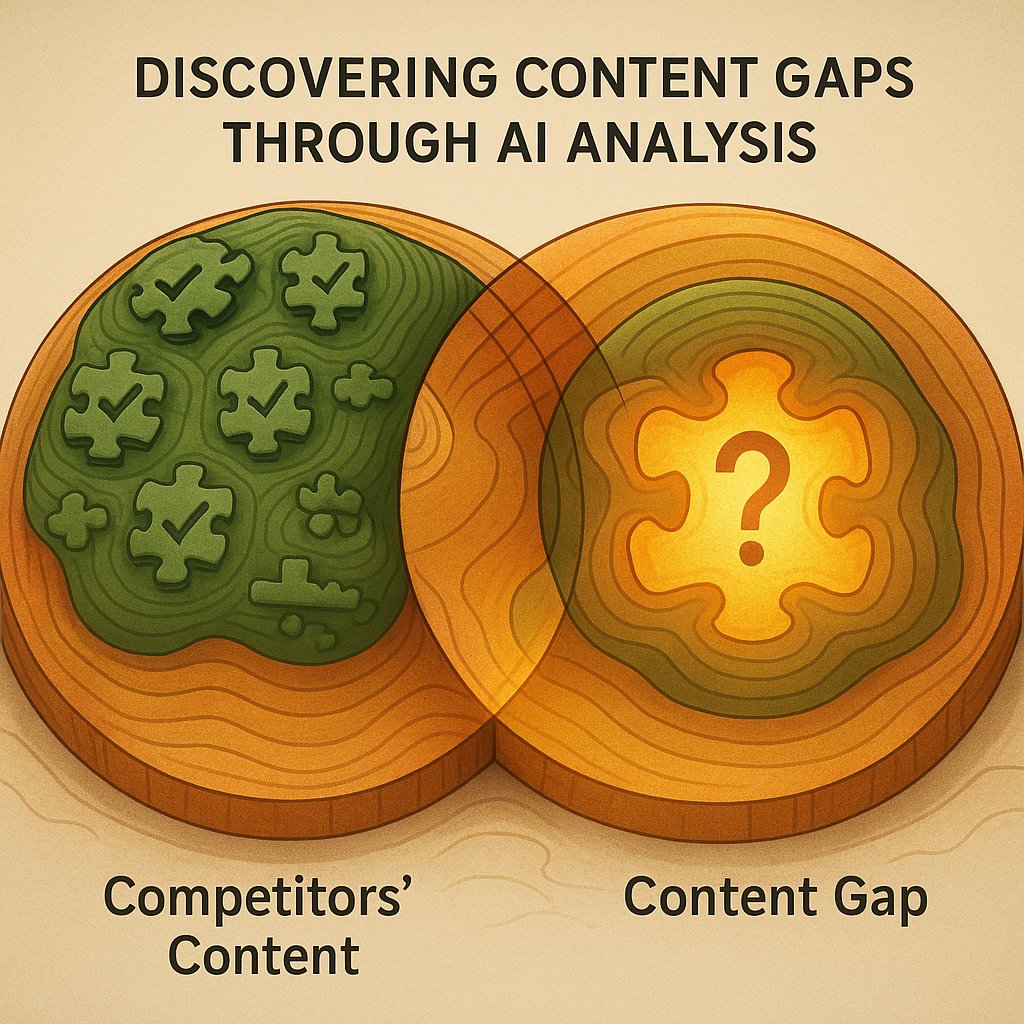
Here’s where AI gets really useful. Feed it your existing content and your competitors’ content. It identifies topics they’re ranking for that you haven’t touched — but more importantly, it spots the semantic gaps within topics you’ve both covered.
Maybe you and your competitor both wrote about email segmentation. But their article covered behavioral triggers and yours didn’t. That’s a gap worth filling, and AI spots it automatically by analyzing content semantic density.
Audience Intent Analysis at Scale
Not all searches are created equal. Someone searching what is content marketing wants different content than someone searching content marketing ROI calculator. One’s learning, the other’s ready to measure performance.
AI tools analyze SERP features, query modifiers, and user behavior signals to classify intent automatically. You get a content plan that matches searcher expectations instead of forcing informational content onto commercial queries (or vice versa).
Practical Implementation: Building Your AI Content Workflow
Theory is useless without execution. Here’s how to actually implement this.
Start With Your Core Topic Universe
Don’t feed AI everything at once. Start with your primary business focus — your core topic. If you sell project management software, that might be project management methodology, team collaboration, and productivity workflows.
Feed these core topics into an AI clustering tool. Let it generate the semantic map. You’re looking for subtopic clusters that could each become a pillar page with supporting content.
Let AI Map Competitor Coverage
Most AI content tools can ingest competitor URLs and extract their topical coverage. Do this for your top three competitors in each core topic area.
You’ll get a visual map showing where they’ve built authority and where they haven’t. More importantly, you’ll see where they’ve all missed the same thing — that’s your wedge.
Generate Content Briefs Automatically
Once you’ve identified gaps, AI tools can create content briefs by analyzing top-ranking pages for target queries. They extract common subtopics, questions addressed, content depth, and even suggest semantic keywords to include.
This doesn’t mean AI writes your content (it shouldn’t). It means your writers start with a research-backed framework instead of a blank page and a vague topic.
Build Feedback Loops With Performance Data
Here’s where it gets powerful: connect your AI planning tool to Google Search Console and Analytics. Now it can see which content actually performs, which topics drove traffic but didn’t convert, and which clusters need reinforcement.
Your content plan becomes self-optimizing. The AI learns your audience’s actual behavior and adjusts recommendations accordingly.
The Internal Linking Layer Nobody Talks About
You’ve got a brilliant AI-powered content plan. Topics clustered perfectly. Gaps identified. Briefs created. You publish thirty new articles.
And then what?
Most teams forget that Google needs to understand those relationships you’ve mapped. Semantic clustering means nothing if your internal links don’t reflect the hierarchy. Your pillar page needs links from supporting content. Related articles need cross-connections. Orphaned pages need integration.
Doing this manually for 30 articles takes hours. For 300 articles, it’s impossible to maintain.
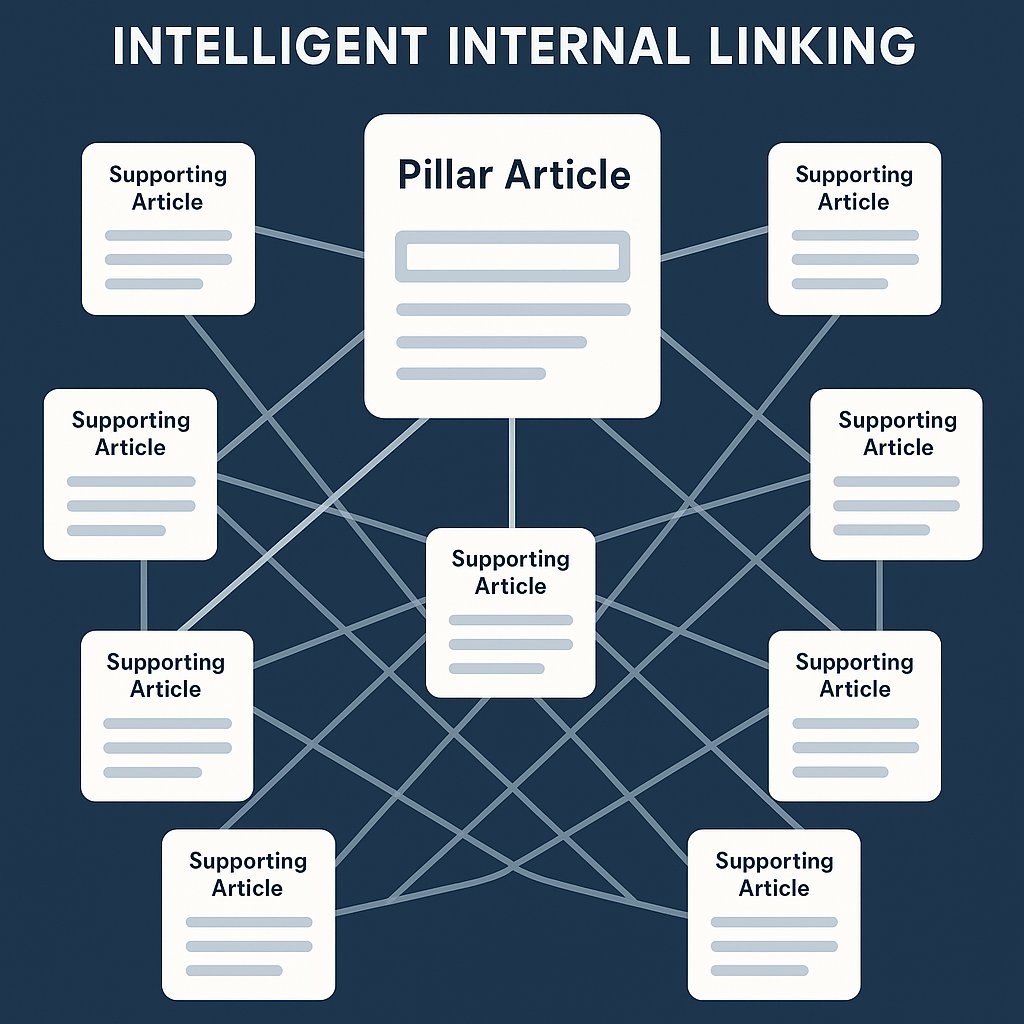
This is where automation becomes essential. Tools like AI Internal Links can analyze your content semantic relationships and create the linking structure automatically. The AI content planning tells you what to create. Internal linking automation ensures Google can understand the architecture you’ve built.
Think of it as closing the loop: AI plans the content strategy, you create the content, AI builds the internal navigation layer. Without that third step, you’ve got great content with broken discoverability.
Common Mistakes When Implementing AI Content Planning
Trusting AI Without Human Validation
AI is phenomenal at pattern recognition. It’s terrible at understanding business context. Just because it identifies a topic gap doesn’t mean that topic serves your business goals.
Always filter AI recommendations through strategic fit. Does this topic move prospects toward a purchase decision? Does it align with product positioning? If not, skip it regardless of search volume.
Optimizing for Volume Over Value
AI can generate hundreds of topic suggestions. That doesn’t mean you should write about all of them. Quality beats quantity every time.
Focus on topics where you can provide genuine expertise or unique perspective. If you’re just repackaging what competitors already said, you’re creating noise, not value.
Ignoring Content Refresh Opportunities
Most teams use AI tools to find new topics but ignore the gold mine sitting in existing content. AI can identify your published articles that are almost ranking — page two results that need a refresh, not a rewrite.
Updating these has faster ROI than creating net-new content. Use AI to prioritize refresh candidates based on ranking position, traffic decline, and keyword opportunity.
The best content strategy isn’t the one with the most articles. It’s the one where every article serves a clear purpose in a larger topical ecosystem.
Measuring Success Beyond Traffic Numbers
Topical Authority Metrics
Traffic is a lagging indicator. Topical authority is predictive. Track how many queries in your core topic areas trigger your content in search results — even if you’re not ranking #1 yet.
Growing topic coverage (measured by SERP impressions across semantic variations) signals that Google views you as increasingly authoritative in that space. Traffic follows authority, not the other way around.
Content Cluster Performance
Don’t measure articles individually. Measure cluster performance: how many conversions came from the entire pillar + supporting content ecosystem? How many pages in the cluster rank on page one?
This shifts focus from hero articles to systematic coverage — which is exactly what AI planning enables.
Content Velocity vs. Planning Time
Before AI: research takes 3 hours per article. After AI: research takes 20 minutes. That’s 9x faster content velocity with better strategic alignment.
Track this metric. It’s the clearest ROI indicator for AI content planning tools.
What This Looks Like Six Months From Now
You’ve built comprehensive topic clusters. Your content library is semantically organized. Internal links connect related pieces automatically. Google understands your topical authority.
New content fits into existing clusters instead of scattering randomly. Writers have AI-generated briefs that ensure consistency. Performance data feeds back into planning, creating a self-improving system.
That’s not a fantasy scenario. That’s what happens when you implement AI content planning systematically instead of using AI as a novelty toy.
The teams winning in SEO right now aren’t the ones creating the most content. They’re the ones using machine learning to create the right content, in the right structure, with the right internal connections. And they’re doing it faster than competitors still working from spreadsheets and intuition.
Start with one core topic. Map it with AI. Build the cluster. Measure the results. Then scale.
The technology is ready. The question is whether you’ll use it before your competitors do.