

Understanding Link Equity and Why It Matters for WordPress Sites
Link equity, often called link juice or PageRank, represents the value and authority passed from one page to another through hyperlinks. When a page with high authority links to another page on your site, it transfers a portion of that authority, potentially boosting the linked page’s ability to rank in search results.
For WordPress site owners, understanding and managing link equity distribution isn’t just an advanced SEO tactic—it’s fundamental to maximizing your site’s overall search visibility. Many websites inadvertently concentrate authority on a handful of pages while leaving valuable content starved of the internal link support it needs to compete in search results.
The challenge becomes particularly acute as your WordPress site grows. What started as a blog with fifty posts can evolve into a content library with hundreds or thousands of pages, each competing for attention from both users and search engines. Without intentional link equity management, your site’s authority gets distributed haphazardly, often reinforcing pages that already rank well while neglecting those that could benefit most from additional internal linking support.
The PageRank Foundation
Google’s original PageRank algorithm, while evolved and now one of hundreds of ranking signals, still provides the conceptual framework for understanding link equity. Pages accumulate authority based on the quantity and quality of links pointing to them. This authority then flows outward through the links on that page, distributed among all outbound links.
In practical terms, your homepage typically accumulates the most authority because it receives the most external backlinks and internal links from navigation menus. That authority can be strategically channeled to important internal pages through contextual links, navigation elements, and structural organization.
Authority Concentration vs. Distribution
Most WordPress sites exhibit what SEO professionals call authority concentration—a small percentage of pages hold the vast majority of the site’s total authority. This often includes the homepage, main category pages, and a few breakout posts that attracted significant backlinks.
While some concentration is natural and even beneficial, extreme concentration leaves opportunity on the table. Pages buried deep in your site architecture, accessible only through multiple clicks, receive minimal authority and struggle to rank even for low-competition keywords.
How Internal Links Transfer Authority in WordPress
The mechanics of authority transfer through internal links involve several factors that WordPress site owners can control and optimize. Understanding these mechanics helps you make strategic decisions about which pages to link, where to place those links, and how to structure your entire linking ecosystem.
Link Position and Context Matter
Not all internal links carry equal weight in transferring authority. Links embedded within the main content area of your page—contextual links—generally pass more value than footer links, sidebar links, or navigation menu items. Search engines recognize that editorial links placed within relevant content indicate stronger topical relationships.
When you link from a paragraph discussing WordPress security plugins to a detailed guide about security hardening, that contextual relevance amplifies the authority transfer. The surrounding content provides semantic signals that help search engines understand the relationship between the two pages.
Anchor Text Influences Topic Relevance
The clickable text of your internal links—the anchor text—communicates what the destination page is about. Using descriptive anchor text that includes relevant keywords helps search engines understand the target page’s topic and can reinforce its relevance for specific queries.
However, WordPress site owners must balance optimization with natural language. Over-optimized anchor text that repeatedly uses exact-match keywords can appear manipulative. A mix of keyword-rich descriptive anchors, branded anchors, and natural language variations creates a more organic linking profile.
Link Quantity and Dilution Effects
Each page has a finite amount of authority to distribute through its outbound internal links. When a page links to five other pages, each receives approximately one-fifth of the distributable authority. When that same page links to fifty pages, the authority per link decreases proportionally.
This dilution effect means strategic selectivity matters. Your highest-authority pages—typically your homepage and popular content—should link thoughtfully to pages that genuinely benefit from that authority boost, rather than scattering links indiscriminately.
Strategic Approaches to Authority Distribution
Effective link equity management requires moving beyond ad-hoc linking decisions toward systematic strategies that align with your site’s goals and content structure. Different approaches work better for different types of WordPress sites and content strategies.
The Hub-and-Spoke Model
This classical approach designates certain pages as authority hubs—comprehensive resources that accumulate links from across your site. These hubs then link outward to related spoke pages, channeling authority to content clusters around specific topics.
For a WordPress site focused on digital marketing, you might create comprehensive guides on SEO, content marketing, and social media as hubs. Each hub accumulates authority through backlinks and internal links from relevant blog posts. The hubs then distribute that authority to more specific articles within their topic area.
The hub-and-spoke model works particularly well for sites with clear topical divisions and evergreen content that can serve as long-term authority centers.
Tiered Architecture for Large Sites
Sites with extensive content libraries benefit from thinking in terms of page tiers based on both importance and existing authority levels. Your homepage sits at the top tier, followed by main category pages and key landing pages in the second tier, with individual posts and articles forming lower tiers.
Authority flows downward through this hierarchy, but strategic upward linking also occurs when lower-tier pages link to relevant higher-tier pages, reinforcing their authority. The key is ensuring that important pages in lower tiers receive sufficient connections to higher-tier pages to accumulate the authority needed to rank competitively.
Topical Cluster Interconnection
Organizing content into topical clusters—groups of related pages all focused on variations of a broader topic—creates natural opportunities for strategic internal linking. A pillar page covers the topic comprehensively at a high level, while cluster pages dive deep into specific subtopics.
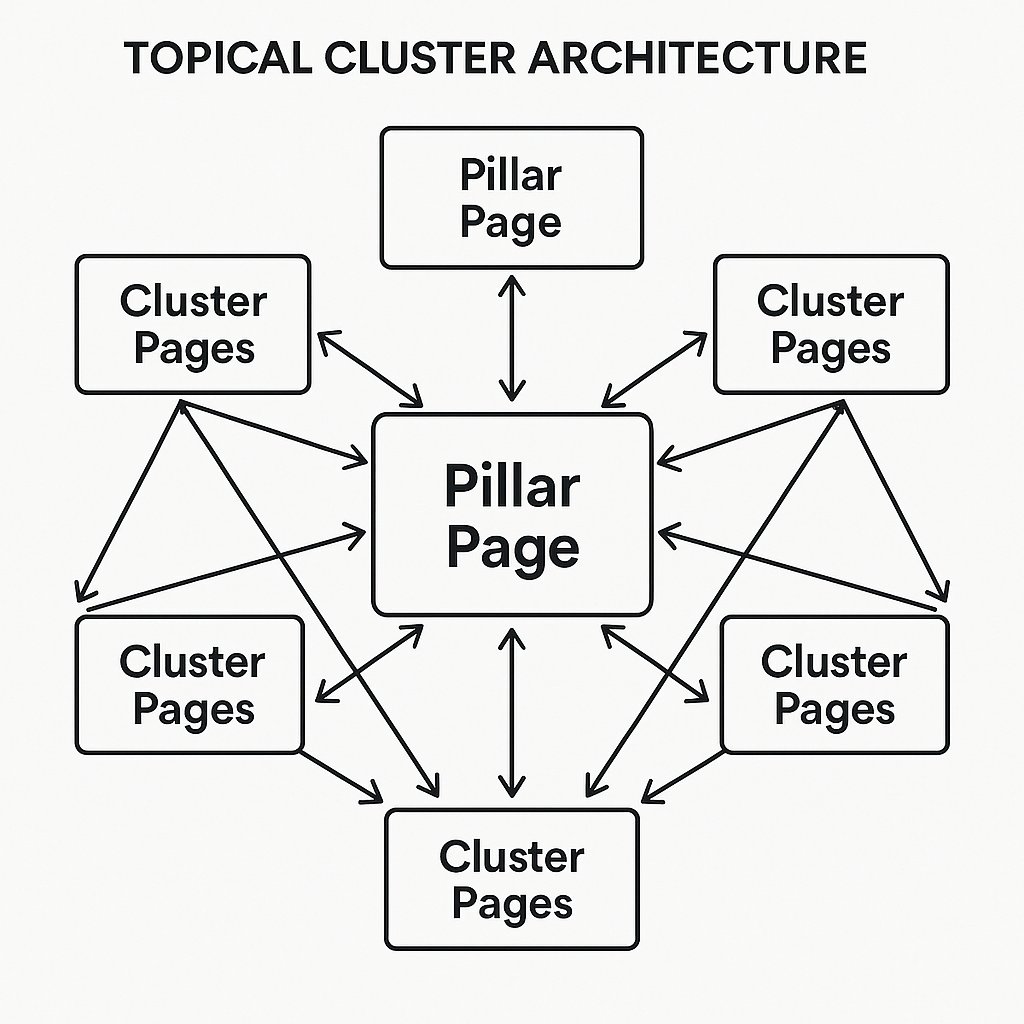
Within this structure, the pillar page links to all cluster pages, and each cluster page links back to the pillar while also connecting to related cluster pages. This dense interconnection signals topical authority to search engines and ensures authority flows efficiently throughout the cluster.
For WordPress sites, organizing categories and tags to reflect these topical clusters helps maintain the structure as you add new content.
Common Link Equity Distribution Mistakes
Even experienced WordPress site managers often make structural decisions that undermine effective authority distribution. Recognizing these patterns helps you audit your existing linking structure and avoid perpetuating problems.
Over-Reliance on Navigation Menus
Many WordPress sites depend heavily on header and footer navigation to connect pages, assuming these sitewide links adequately distribute authority. While navigation links do pass value, their impact diminishes across hundreds or thousands of pages because the authority gets divided among so many destinations.
Moreover, navigation links lack the contextual relevance that makes contextual content links more valuable. A footer link from your privacy policy page to your about page carries less weight than a contextual link embedded in relevant content.
Ignoring Crawl Depth
Pages buried four, five, or more clicks away from your homepage exist in a kind of SEO purgatory. Search engine crawlers may reach them eventually, but they receive minimal authority and often rank poorly despite quality content.
Every additional click required to reach a page typically results in exponentially fewer visitors and less authority. Strategic internal linking can promote important deep pages by creating shorter paths from high-authority pages.
Letting High-Authority Pages Hoard Equity
Your most successful pages—those with numerous backlinks and strong rankings—accumulate substantial authority. If these pages link only sparingly to other internal content, they essentially hoard that authority rather than channeling it strategically.
Regularly auditing your highest-authority pages and ensuring they include relevant contextual links to related content helps redistribute that accumulated equity where it can generate additional rankings and traffic.
Inconsistent Linking Patterns
Without systematic approaches, internal linking often reflects whoever wrote each piece of content rather than strategic intent. One author might include five internal links per post, another includes none, and linking decisions reflect convenience rather than equity distribution goals.
This inconsistency means opportunity gets left on the table. Valuable pages that could rank with additional authority support remain under-linked, while other pages receive redundant links that provide diminishing returns.
Implementing Link Equity Optimization on WordPress
Translating link equity concepts into practical WordPress implementations requires both technical understanding and content strategy. The platform’s flexibility allows for multiple approaches depending on your site’s size and resources.
Identifying Authority Concentration Points
Start by identifying where authority currently concentrates on your site. Tools like Ahrefs, Moz, or SEMrush can show you which pages have accumulated the most backlinks and internal links. Your WordPress analytics can reveal which pages attract the most traffic and engagement.
These high-authority pages represent your primary opportunities for strategic authority distribution. Audit their outbound internal links to ensure they’re connecting to pages that align with your current content and SEO priorities.
Mapping Content Relationships
Create a content map that visualizes topical relationships across your site. Which posts naturally relate to others? Which evergreen guides should serve as authority hubs? Which newer content would benefit most from authority boosts?
This mapping process often reveals gaps—important pieces of content that lack sufficient connection to your authority structure, or topic areas that need better internal cohesion. It also highlights opportunities to create new content that bridges existing gaps.
Creating Systematic Linking Workflows
Rather than treating internal linking as an afterthought when publishing new content, integrate it into your editorial workflow. Before publishing any new WordPress post, identify opportunities to link from existing high-authority content and ensure the new post links strategically to relevant existing pages.
For larger WordPress sites with extensive content libraries, manual linking becomes increasingly challenging. Tools like AI Internal Links can automate this process by analyzing semantic relationships between pages and suggesting or implementing contextual links that distribute authority according to your content structure.
Leveraging WordPress Categories and Tags
WordPress’s built-in taxonomy system—categories and tags—creates automatic archive pages that can serve in your authority distribution strategy. Well-organized category pages accumulate authority through navigation links and can pass that authority to posts within the category.
However, category and tag archives also create potential equity dilution if used excessively. Many SEO professionals recommend limiting the number of categories and using tags sparingly to avoid fragmenting your site’s authority across too many archive pages.
Using Related Posts Strategically
Related posts plugins are common on WordPress sites, automatically suggesting content at the end of posts. While convenient, these automated suggestions often lack the strategic focus needed for optimal equity distribution.
If you use related posts functionality, configure it to prioritize pages that benefit most from authority boosts rather than simply showing the most recent or most popular content. Better yet, manually curate related content selections for your most important pages.
Monitoring and Adjusting Your Link Equity Strategy
Link equity optimization isn’t a one-time implementation but an ongoing process that evolves with your content and search landscape. Regular monitoring helps you identify what’s working and where adjustments could yield better results.
Tracking Rankings and Authority Metrics
Monitor how pages respond to internal linking changes. When you add contextual links from high-authority pages to a target page, track whether that page’s rankings improve over the following weeks and months. Look at metrics like organic traffic, keyword rankings, and referring domains.
Some pages will respond dramatically to internal linking improvements, while others may need additional factors addressed. This feedback loop helps refine your understanding of how authority distribution affects your specific site.
Conducting Regular Link Audits
Quarterly or semi-annual internal link audits help maintain the health of your link equity distribution strategy. Review your highest-authority pages to ensure they’re still linking to your priority content. Check for broken internal links that interrupt authority flow. Identify pages that have become orphaned—unreachable through internal links—and reconnect them to your site structure.
As your WordPress site evolves, content priorities shift and new pages deserve promotion while older content may become less central to your strategy. Your internal linking structure should reflect these changes.
Balancing Authority Distribution with User Experience
While optimizing for search engines, never lose sight of user experience. Internal links exist primarily to help visitors navigate your content and discover related information. Links that feel forced, irrelevant, or excessive harm user experience even if they technically pass authority.
The most sustainable link equity strategies align SEO benefits with genuine user value. When internal links help readers find answers to related questions or explore topics more deeply, you create positive engagement signals that complement the direct ranking benefits of authority distribution.
Advanced Link Equity Tactics for Competitive Niches
Sites competing in highly competitive niches need sophisticated approaches to link equity distribution that go beyond basic best practices. These advanced tactics require more effort but can provide the edge needed to compete against established competitors.
Strategic Nofollow Implementation
Most internal links should be followed, allowing authority to flow naturally. However, strategic use of nofollow attributes on certain internal links can concentrate authority more intensely on priority pages. This technique requires careful consideration, as overly aggressive nofollow use can disrupt natural authority distribution.
Consider nofollow for links to administrative pages, login pages, or low-value tag archives that don’t need to accumulate authority. This preserves more equity for pages that drive business results.
Temporal Authority Boosts
When launching important new content or trying to rank for competitive keywords, temporarily increase internal linking to those pages from high-authority sources. This concentrated authority boost can help the page gain initial traction in search results.
Once the page establishes its own authority and rankings, you can reduce the number of internal links pointing to it, redirecting that authority to other priority pages. This tactical approach treats link equity as a resource to be deployed strategically rather than set permanently.
Authority Recycling from Declining Pages
Some pages naturally decline in relevance and authority over time as topics evolve or content becomes outdated. Rather than letting that accumulated authority languish on declining pages, redirect them to updated content or add prominent internal links channeling visitors and authority to current priority pages.
This authority recycling ensures your site’s total equity continually flows to pages that can generate current value rather than being locked in legacy content.
Scaling Link Equity Management
The strategies discussed become increasingly complex as WordPress sites scale. A site with 10,000 posts faces dramatically different challenges than one with 100 posts, and manual link equity management becomes impractical beyond a certain size.
The Complexity Challenge
Manually managing internal links for comprehensive equity distribution requires understanding the authority level of every page, the topical relationships between all content, the existing link structure, and the optimal linking opportunities. For large sites, this represents thousands of relationships to track and optimize.
Even dedicated SEO teams struggle to maintain optimal internal linking at scale. Links get missed, opportunities go unrecognized, and the linking structure becomes increasingly inconsistent as different team members make independent decisions.
Automation and Intelligence
Advanced WordPress sites increasingly turn to intelligent automation to manage link equity distribution at scale. By analyzing semantic relationships, existing authority patterns, and content structures, automated systems can identify optimal linking opportunities that humans might miss in large content libraries.
These systems can also maintain consistency in linking patterns, ensuring every new post receives appropriate internal linking support and contributes to the broader authority distribution strategy regardless of who created the content.
Balancing Control and Efficiency
The goal isn’t replacing human strategy with automation but rather augmenting human decision-making with tools that handle the execution complexity. SEO professionals define the strategy—which topics to prioritize, which pages deserve authority boosts, which content clusters need reinforcement—while automation handles the detailed implementation across hundreds or thousands of pages.
This division of labor allows link equity optimization to scale without requiring proportionally larger teams or consuming unsustainable amounts of time.
Conclusion: Authority Distribution as Ongoing Strategy
Effective link equity distribution transforms your WordPress site from a collection of individual pages into an interconnected authority network where every piece of content supports and amplifies the others. Pages that might languish in search results when isolated gain the authority boost needed to compete when properly integrated into your internal linking structure.
The most successful WordPress sites treat link equity management not as a technical SEO checkbox but as an ongoing strategic priority. Regular audits, systematic linking workflows, and intelligent use of your highest-authority pages ensure that accumulated equity continuously flows to pages that can generate additional rankings, traffic, and business value.
Whether you manage linking manually for a smaller site or leverage automation for larger content libraries, the fundamental principles remain constant: understand where authority concentrates, identify pages that would benefit from authority boosts, create contextual links that serve both users and search engines, and continuously refine your approach based on results.
As your WordPress site grows and evolves, your link equity distribution strategy should grow with it, ensuring that every piece of valuable content has the internal support structure needed to achieve its full ranking potential.