

Recent data from Ahrefs’ analysis of 23 million pages shows that websites with strategic internal linking structures achieve 40-50% better crawl efficiency and significantly higher rankings for competitive keywords. The key difference between sites that leverage internal links effectively and those that don’t often comes down to systematic implementation rather than random linking.
The Foundation of Strategic Internal Linking
Internal links serve multiple critical functions in modern SEO. They distribute PageRank throughout your site, guide search engine crawlers to important pages, establish content hierarchy, and create pathways for users to discover related information. However, the approach to internal linking has evolved significantly from simply adding a few related post links at the bottom of articles.
Understanding Link Equity Flow
Every page on your website accumulates authority through external backlinks and internal connections. This authority, often called link equity or PageRank, flows through internal links to other pages. Strategic internal linking ensures your most valuable pages receive maximum authority distribution.
Research from Moz indicates that homepage typically holds 60-70% of a site’s total link equity. Without proper internal linking, this authority concentrates at the top level while important blog posts and product pages languish with minimal authority. A structured approach redistributes this power effectively across your entire site architecture.
The Hub and Spoke Model
The hub and spoke model, also called the pillar-cluster strategy, has become the gold standard for modern internal linking. This approach involves creating comprehensive pillar pages on broad topics and surrounding them with detailed cluster content on specific subtopics.
For example, a pillar page on “Content Marketing Strategy” might link to cluster pages covering “Email Marketing Tactics,” “Social Media Content Planning,” “SEO Content Optimization,” and “Video Marketing Techniques.” Each cluster page then links back to the pillar and potentially to related cluster content.
Websites implementing this structure report average organic traffic increases of 35-45% within six months. The structured approach helps search engines understand topic relationships while providing clear navigation paths for users.
Anchor Text Optimization for Internal Links
Anchor text selection significantly impacts how search engines interpret your internal linking structure. Unlike external links where exact-match anchors can trigger penalties, internal links offer more flexibility for descriptive, keyword-rich anchor text.
Balancing Keyword Optimization and Natural Language
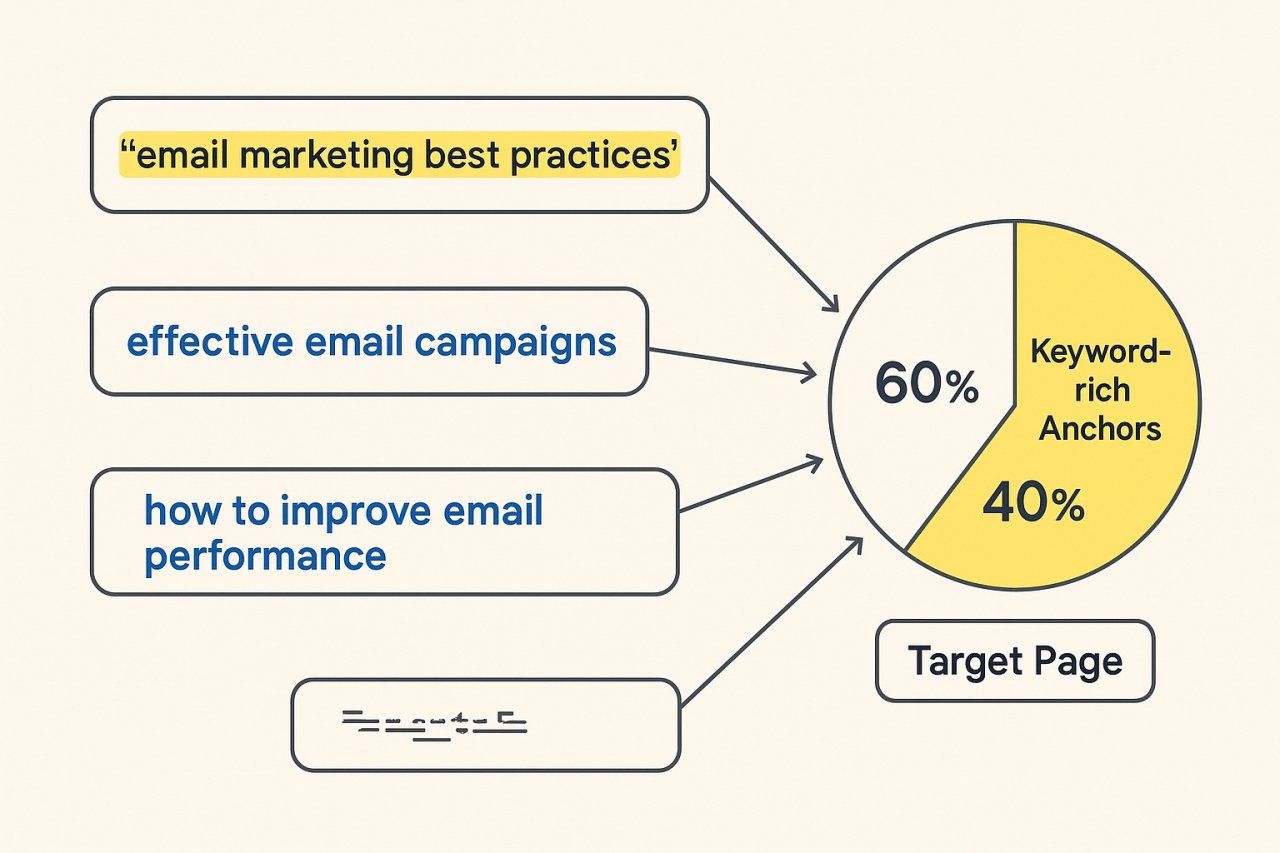
The most effective internal linking strategies use a mix of 60% descriptive keyword anchors and 40% natural language variations. For instance, linking to a page about email marketing might use anchors like “email marketing best practices,” “effective email campaigns,” “how to improve email performance,” and occasionally “learn more about email strategy.”
Avoid generic anchors like “click here,” “read more,” or “this article” as they provide zero context to search engines about the destination page’s content. Data from SEMrush’s 2024 ranking factors study shows that descriptive anchor text correlates with a 23% higher probability of ranking for target keywords.
Avoiding Over-Optimization
While internal links allow more keyword usage than external links, excessive exact-match anchors can still appear manipulative. If every internal link to your “best running shoes” page uses that exact phrase, you’re creating an unnatural pattern that sophisticated algorithms can detect.
Distribute anchor text variations naturally throughout your content. Use related terms like “top running footwear,” “recommended running shoes,” “high-performance running sneakers,” and contextual phrases that fit naturally within sentences.
Strategic Link Placement and Context
Where you place internal links within your content matters as much as the anchor text itself. Links positioned in the main content body carry more weight than those in sidebars, footers, or navigation menus.
The First 100 Words Premium
Search engines place higher value on links appearing early in the content. An internal link within the first 100-150 words of an article receives approximately 30% more weight than identical links positioned near the end. This phenomenon, confirmed through various SEO experiments, reflects how search algorithms prioritize content structure.
Strategically place your most important internal links in the introduction or early paragraphs. If you’re linking to a critical pillar page or high-priority content, ensure it appears naturally within the opening context rather than buried in concluding remarks.
Contextual Relevance and Topic Clustering
Links surrounded by relevant content carry more authority than those placed randomly. If you’re writing about social media marketing and link to a page about email campaigns, ensure the surrounding sentences discuss multi-channel marketing or related concepts that justify the connection.
Tools like Screaming Frog SEO Spider help analyze existing internal link contexts by extracting anchor text and surrounding content. This analysis reveals opportunities to improve contextual relevance and identify weak connections that provide minimal SEO value.
Technical Implementation Strategies
Building an effective internal linking structure requires systematic implementation rather than ad-hoc additions. Several approaches have proven successful across different website types and sizes.
The 3-Click Rule for Site Architecture
Users and search crawlers should reach any page on your website within three clicks from the homepage. This principle ensures efficient crawling and prevents deep pages from becoming orphaned or receiving insufficient authority.
Conduct regular site audits using tools like Ahrefs Site Audit or Screaming Frog to identify pages requiring more than three clicks to access. These isolated pages often represent missed opportunities for traffic and conversions despite containing valuable content.
Automated Internal Linking Solutions
Manually adding internal links to every new piece of content becomes increasingly challenging as websites grow. WordPress plugins like AI Internal Links automate this process by analyzing content and generating relevant internal links in one click, saving hours of manual work while maintaining linking consistency.
These tools identify contextually appropriate linking opportunities by analyzing keyword relationships and content similarity. They prevent the common problem of forgetting to link new content to existing articles or missing obvious connections between related topics.
Regular Content Audits and Updates
Internal linking isn’t a one-time task but an ongoing optimization process. Websites publishing regularly should conduct quarterly internal linking audits to identify opportunities for connecting new content with existing articles.
When you publish a comprehensive new article on a topic, review previous content that should link to it. Similarly, the new article should link to relevant existing pages. This bidirectional linking creates a robust content network that search engines reward with better visibility.
Measuring Internal Linking Effectiveness
Tracking the impact of internal linking improvements requires monitoring specific metrics that indicate performance changes.
Key Performance Indicators
Internal linking success manifests through several measurable outcomes:
- Organic traffic to previously underperforming pages typically increases 25-40% within 2-3 months of strategic internal linking improvements
- Pages per session and average session duration improve as users discover more relevant content through internal pathways
- Crawl depth distribution becomes more balanced, with fewer pages requiring excessive clicks to access
- Ranking improvements for target keywords appear within 4-8 weeks for pages receiving additional internal link equity
- Bounce rate reductions of 15-25% occur when strategic internal links guide users to complementary content
Tools for Tracking Performance
Google Search Console provides valuable data through the Links report, showing which pages receive the most internal links and how link distribution affects crawling patterns. Monitor the “Top linked pages” section to ensure your priority content receives proportional attention.
Google Analytics 4 reveals user navigation patterns through the Path Exploration report. This visualization shows how users move between pages, highlighting which internal links generate the most engagement and which connections go unused despite their strategic placement.
Common Internal Linking Mistakes to Avoid
Even experienced website owners make critical internal linking errors that undermine their SEO efforts.
Link Hoarding on High-Authority Pages
Many sites accumulate dozens of external backlinks to their homepage or a few popular articles but fail to distribute that authority effectively. A homepage with 50 internal links pointing away dilutes link equity significantly compared to strategic linking to 8-12 priority pages.
Prioritize quality over quantity in internal linking. Each homepage link should serve a clear purpose rather than attempting to promote every category and subcategory simultaneously.
Orphaned Pages and Dead Ends
Pages without any internal links pointing to them, called orphaned pages, receive no link equity and may not be crawled regularly. Studies show orphaned pages achieve 90% less organic traffic than properly integrated content.
Similarly, pages that don’t link out to other internal content create dead ends where user journeys terminate prematurely. Every page should provide 3-5 relevant internal linking opportunities to continue the user’s exploration.
Neglecting Deep Content Updates
When updating older content, many site owners refresh information without reconsidering internal linking opportunities. A blog post from 2020 might not link to valuable resources published in 2023-2024, representing missed connections that would benefit both pieces of content.
Implement a systematic approach where content updates include internal linking reviews. Identify newer articles that relate to the updated piece and add natural connections between them.
Advanced Internal Linking Tactics for Competitive Niches
Sites competing in challenging industries require sophisticated internal linking approaches beyond basic best practices.
Strategic Orphan Page Recovery
Some pages perform well organically despite limited internal links, indicating strong external backlink profiles or search demand. Identifying these pages and strategically adding 5-8 high-quality internal links from relevant content can boost their rankings substantially.
Run regular analyses using Ahrefs or SEMrush to find pages with good external backlinks but few internal connections. These represent low-hanging fruit for quick ranking improvements through better internal linking.
Seasonal and Trending Content Integration
Websites with seasonal content or trending topics need flexible internal linking structures that adapt throughout the year. Create temporary internal link campaigns that boost seasonal pages 4-6 weeks before peak demand, then redirect that linking attention to other priorities during off-seasons.
For example, a retail site might heavily link to holiday gift guides from October through December, then shift those prominent links to spring product categories in January. This dynamic approach maximizes the SEO value of timely content while maintaining overall site authority.
Competitor Gap Analysis
Analyze top-ranking competitor sites to identify internal linking patterns contributing to their success. Tools like Ahrefs Site Explorer reveal how competitors structure their internal links, which pages receive priority treatment, and how deeply they interconnect related content.
This competitive intelligence often reveals overlooked opportunities in your own internal linking strategy. If competitors consistently link certain content types together while you don’t, that pattern likely contributes to their ranking advantage.
Future-Proofing Your Internal Linking Strategy
Search algorithms continue evolving, but internal linking fundamentals remain remarkably stable. The core principle of helping users and search engines discover valuable content through logical connections will remain relevant regardless of algorithm updates.
Focus on building scalable systems rather than manual processes that become unmanageable as your site grows. Whether through automation tools, systematic content audits, or team workflows, establish processes that maintain internal linking quality without requiring exponentially more resources.
Websites that treat internal linking as a foundational element of their content strategy rather than an afterthought consistently outperform competitors who neglect this powerful SEO lever. With proper implementation, internal linking delivers compounding returns as your content library grows and authority accumulates across an increasingly interconnected site structure.