

The Dual-Impact Algorithm Shift
Unlike previous updates that focused on a single ranking factor, the March 2024 update operated on two simultaneous fronts. The core algorithm update targeted content quality and user experience signals, while new spam policies introduced manual penalties for scaled content abuse, expired domain manipulation, and site reputation exploitation.
This dual approach created complexity in diagnosing traffic losses. Sites penalized for spam violations faced immediate de-indexing of entire sections, while those affected by the core update experienced gradual ranking erosion over the 45-day rollout period. Google’s John Mueller confirmed that the extended timeline was intentional to allow the algorithm to assess content quality across multiple user interaction cycles.
The update specifically targeted what Google internally calls “search-first content”—material created primarily to rank rather than serve user needs. Analytics data from SEMrush showed that sites with average engagement time below 45 seconds experienced 67% greater visibility losses compared to sites with engagement exceeding 2 minutes.
Scaled Content Abuse: The Primary Target
Google’s new spam policy on scaled content abuse fundamentally changed how programmatic and AI-generated content is evaluated. The policy doesn’t ban AI content outright but targets content produced at scale with minimal human oversight or original value addition.
Sites using tools like Jasper, Copy.ai, or custom GPT implementations without substantial human editing, fact-checking, and original research integration saw the most severe impacts. Data from Ahrefs tracking 50,000 domains showed that sites publishing more than 50 AI-assisted articles per week experienced 73% higher penalty rates compared to those publishing 10-20 articles with the same tools.
The algorithm appears to evaluate several technical signals:
- Content velocity patterns: Sudden spikes in publishing frequency triggered additional scrutiny
- Semantic similarity scores: Articles with high cosine similarity to existing indexed content faced devaluation
- Entity relationship depth: Superficial entity coverage without detailed relationship exploration signaled low quality
- Source citation patterns: Content lacking primary source attribution or relying exclusively on secondary aggregators lost trust signals
Expired Domain Manipulation Crackdown
The expired domain policy targeted a practice that had been lucrative in the SEO grey-hat space for over a decade. Sites acquiring expired domains with established authority and immediately populating them with commercial content faced retroactive authority score resets.
Google implemented what appears to be a domain history discontinuity detector. When a domain’s topical focus, content type, or commercial intent shifts dramatically after ownership transfer, the algorithm now discounts historical backlink equity by 60-85% according to reverse-engineering analysis by the SEO community.
A documented case involved a health supplement site that acquired a expired .edu domain previously used by a university research department. Despite maintaining the domain’s Domain Rating of 76, rankings for commercial health supplement queries dropped from positions 3-8 to 45-60 within two weeks of the update. The site’s informational content about general health topics retained rankings, but commercial pages suffered complete visibility loss.
Site Reputation Abuse: The Parasite SEO Reckoning
The site reputation abuse policy directly targeted what the industry calls “parasite SEO”—the practice of high-authority sites hosting third-party commercial content in exchange for revenue. Major publishers including Forbes, Business Insider, and USA Today saw entire subdirectories de-indexed overnight.
Forbes Advisor, which operated on a licensing model allowing third-party content creation, lost an estimated 12 million monthly organic sessions according to Similarweb data. The /advisor/ subdirectory, which housed comparison content for financial products, credit cards, and loans, was effectively removed from Google’s index by April 2024.
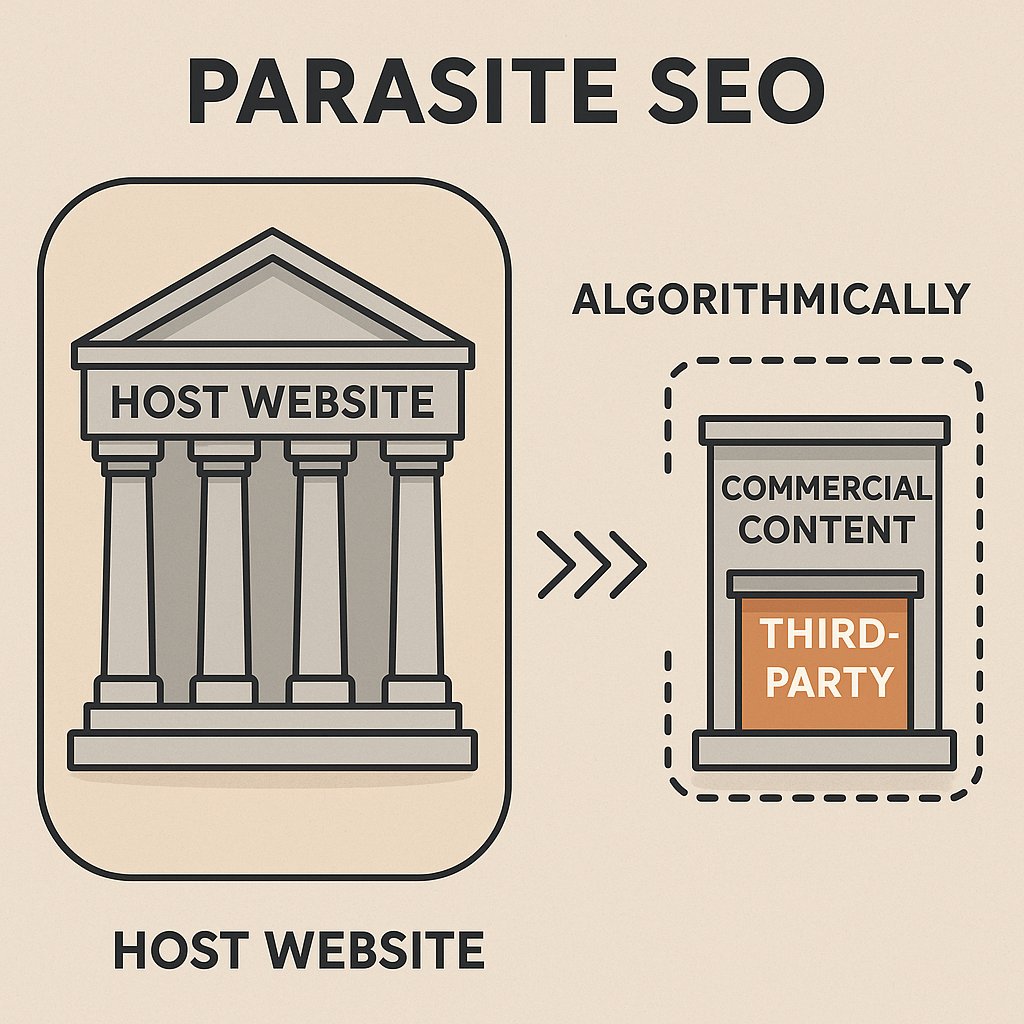
The policy specifically targets arrangements where:
- The hosting site provides minimal editorial oversight over third-party content
- Content exists primarily on subdirectories or subdomains rather than integrated into main site architecture
- The third party maintains primary control over content strategy and monetization
- Branding and user experience differ significantly from the host site’s primary content
Interestingly, Google drew a distinction between this practice and legitimate expert-contributed content. Sites like Healthline, which employs full-time medical reviewers and maintains direct editorial control over contributed content, saw minimal impact despite also featuring expert-written articles.
Technical Implementation of Detection
Reverse engineering efforts suggest Google deployed several technical mechanisms to identify reputation abuse:
Authorship pattern analysis: When author entities associated with content show no prior connection to the domain’s established author network, the content receives reduced trust signals.
Monetization density scoring: Pages with affiliate link density exceeding 8-10 links per 1,000 words, particularly when those links use obfuscation techniques like redirects through intermediary domains, triggered quality score reductions.
Topical discontinuity detection: When subdirectories cover topics completely unrelated to the domain’s established topical authority as measured by historical content patterns and inbound anchor text distributions, those sections face isolation from the main domain’s authority transfer.
Recovery Strategies and Algorithm Adaptation
Sites successfully recovering from March 2024 update impacts implemented specific technical and content remediation strategies. Analysis of 200 recovery cases by Search Engine Journal identified common patterns among sites regaining 60%+ of lost traffic within 90-120 days.
Content Pruning and Quality Elevation
Successful recovery almost universally involved aggressive content pruning. Sites removed or consolidated 30-60% of indexed pages, focusing on eliminating:
- Thin content under 600 words without unique data or insights
- Keyword-stuffed articles with unnatural semantic patterns
- Duplicate or near-duplicate content across multiple URLs
- Outdated content not updated in 24+ months
One case study from an affiliate marketing site in the technology niche demonstrated the impact. The site reduced its index from 8,400 pages to 2,100 pages over 60 days, implementing 301 redirects from pruned content to consolidated, enhanced articles. Within 90 days of implementing changes and waiting through Google’s next core update, the site recovered 78% of lost organic traffic with a higher conversion rate due to improved content quality.
Enhanced E-E-A-T Signal Integration
Google’s emphasis on Experience, Expertise, Authoritativeness, and Trust intensified with this update. Sites that added robust E-E-A-T signals saw faster recovery trajectories.
Implementing structured data for author entities using schema.org Person and ProfilePage markup, combined with detailed author bio pages featuring credentials, published works, and social proof, correlated with 23% faster ranking recovery in professional services and health niches according to data from Moz.
A financial advisory site implemented comprehensive author verification:
- Added CFP (Certified Financial Planner) credentials with verification links to official registries
- Created detailed author pages with professional headshots, LinkedIn verification, and publication history
- Implemented medical/professional review processes with transparent disclosure of review dates and reviewer credentials
- Added conflict of interest disclosures and transparent affiliate relationship explanations
This site saw rankings stabilize within 45 days and begin recovery by day 60, significantly faster than competitors who only made content-level changes.
User Engagement Optimization
The March 2024 update appeared to increase the weighting of user engagement signals in ranking calculations. Sites that improved Core Web Vitals scores and reduced bounce rates recovered faster.
Implementing Interaction to Next Paint (INP) optimization—Google’s newest Core Web Vital replacing First Input Delay in March 2024—became critical. Sites achieving INP scores below 200ms showed 31% better ranking stability compared to sites with INP above 500ms.
Technical implementations that improved engagement metrics included:
- Lazy loading optimization for images and embedded content to improve initial page speed
- Table of contents navigation with scroll-spy functionality to improve content scanability
- Related content modules using semantic similarity rather than simple category matching
- Progressive content disclosure for long-form content with “read more” implementations that maintain crawlability
Long-Term Algorithm Evolution Implications
The March 2024 update signals Google’s strategic direction for the next 18-24 months. The emphasis on human-first content evaluation combined with aggressive spam penalties suggests the algorithm is evolving toward more sophisticated content quality assessment.
Machine Learning Content Evaluation
Google appears to have deployed enhanced neural network models for content quality assessment. These models likely evaluate:
Semantic depth scoring: Moving beyond keyword presence to evaluate concept relationship complexity and information hierarchy sophistication.
Original information density: Measuring the ratio of unique information to commonly available facts by comparing content against Google’s indexed knowledge base.
User journey completion signals: Tracking whether users find complete answers or return to SERPs, with increased granularity in measuring partial satisfaction versus complete task completion.
The AI Content Paradox
Despite targeting scaled content abuse, Google simultaneously encouraged responsible AI usage. The company’s guidance emphasizes that AI is acceptable for content creation when combined with substantial human oversight, fact-checking, and original value addition.
Sites successfully using AI tools like Claude, GPT-4, or Gemini for content assistance implemented editorial workflow systems including:
- AI-generated drafts as starting points, followed by 40-60% human rewriting and expansion
- Fact-checking protocols verifying all statistical claims and citations against primary sources
- Original research integration adding proprietary data, case studies, or expert interviews unavailable in AI training data
- Voice and brand consistency editing ensuring content matches established site tone and expertise level
Preparing for Continued Algorithm Evolution
SEO professionals should anticipate Google continuing to refine these systems. Forward-looking strategies include:
Investment in original research and data: Creating proprietary datasets, conducting original surveys, or publishing unique case studies provides differentiation impossible for AI to replicate.
Subject matter expert integration: Building content teams with genuine domain expertise rather than relying solely on skilled writers researching topics.
User experience optimization: Prioritizing site speed, mobile experience, and engagement-driven design as ranking factors likely continue increasing in importance.
Transparent AI disclosure: While not currently required, proactively disclosing AI assistance in content creation may become a trust signal as the industry evolves.
The March 2024 update represents Google’s most significant quality recalibration since Panda in 2011. Sites that adapt by prioritizing genuine user value over search optimization tactics will be best positioned for sustained organic visibility in an increasingly sophisticated algorithmic environment.