
Table of Contents
- Why Machine Learning SEO Tools Changed Everything
- AI-Powered Keyword Research That Actually Works
- Content Optimization That Learns From Rankings
- Automation SEO: The Tasks You Should Stop Doing Manually
- Machine Learning Ranking Algorithms: What SEOs Need to Know
- Choosing AI SEO Tools That Actually Deliver
- The Reality Check: What AI Can’t Do
- The Competitive Advantage Is Narrowing
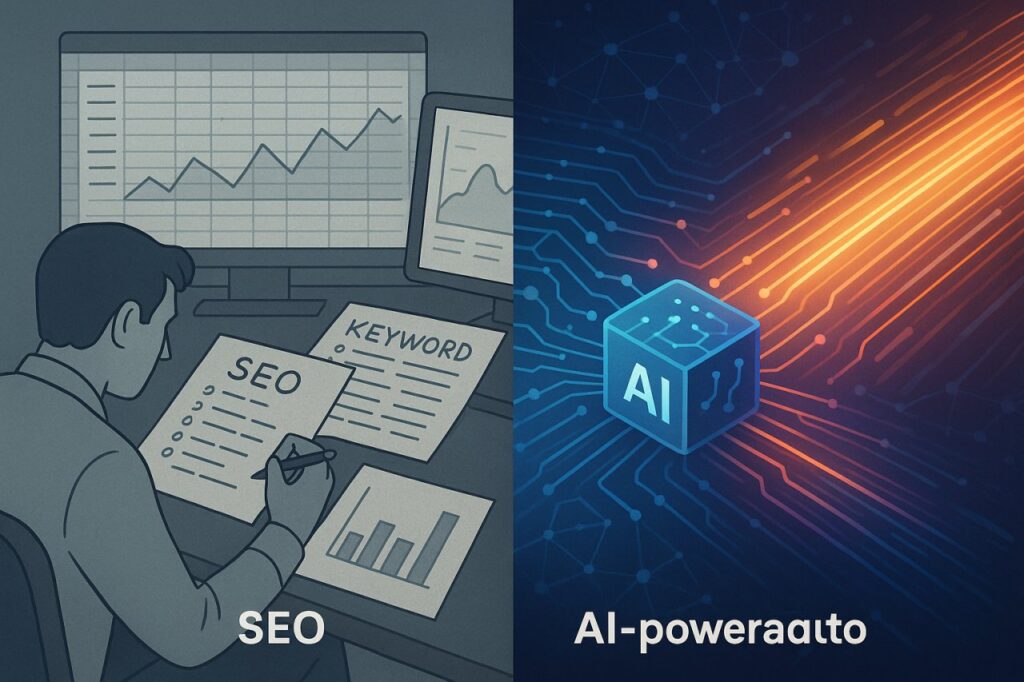
If you’re still spending three hours researching keywords or manually checking every internal link on your site, you’re competing with people who’ve automated those tasks down to minutes. Machine learning has fundamentally changed what’s possible in SEO, and the tools available right now would’ve seemed like science fiction just five years ago.
This isn’t about replacing human strategy. It’s about amplifying what you can accomplish with the same 24 hours everyone else gets. The question isn’t whether AI will transform your SEO workflow — it’s whether you’ll be early or late to that transformation.
Why Machine Learning SEO Tools Changed Everything
Google Already Uses AI — You’re Just Catching Up
Here’s the reality check: Google’s ranking algorithms have been powered by machine learning since RankBrain launched in 2015. BERT, MUM, and now Search Generative Experience all rely on artificial intelligence to understand content. You’re optimizing for an AI judge whether you like it or not.
The playing field shifted. Traditional SEO was about matching keywords and building links. Modern SEO is about understanding semantic relationships, user intent patterns, and topical authority — exactly what machine learning excels at analyzing.
The Data Volume Problem
You can’t manually analyze 50,000 keyword variations or audit internal links across 2,000 pages. Your brain isn’t wired for that scale. AI-powered SEO tools process in seconds what would take humans weeks.
This isn’t laziness — it’s leverage. Every hour you spend on mechanical tasks is an hour you’re not spending on strategic decisions that actually move the needle.
Pattern Recognition at Machine Speed
Machine learning algorithms spot patterns humans miss. They’ll notice that your articles with three-level heading structures consistently outrank those with two levels. They’ll identify which internal linking patterns correlate with pages jumping from position 15 to position 3.
The best part? They learn from your specific site, not generic best practices that may or may not apply to your niche.
AI-Powered Keyword Research That Actually Works
Beyond Search Volume Metrics
Old-school keyword tools give you search volume and competition scores. AI SEO tools in 2026 predict which keywords will drive actual conversions based on semantic intent analysis and historical performance patterns.
They analyze SERP features for each keyword, identify question variations, and cluster related terms into topical groups. Instead of a spreadsheet with 500 keywords, you get a strategic roadmap.
Real-Time Trend Detection
Traditional keyword research is backward-looking. You see what people searched last month. Machine learning models detect emerging trends before they spike by analyzing search pattern velocity and related query growth.
This means you can create content for rising queries while competition is still low. By the time everyone else notices the trend, you’re already ranking.
Intent Classification at Scale
AI-powered keyword research automatically categorizes search intent — informational, navigational, commercial, transactional. No more guessing whether someone searching best running shoes wants to buy or just learn.
The tools analyze actual SERP results, identify dominant content types, and tell you exactly what format Google expects. Shopping results? You need product pages. Featured snippets? You need concise answers followed by depth.
Content Optimization That Learns From Rankings
Moving Beyond Keyword Density
Remember when SEO meant hitting a 2% keyword density? Artificial intelligence content optimization analyzes semantic relationships, not just word frequency. Modern AI tools understand that machine learning, neural networks, and deep learning algorithms are conceptually connected.
They’ll suggest related terms not because they appear in competitor content, but because they strengthen your topical relevance signal to Google’s algorithms.

Readability Optimization With Context
AI writing assistants don’t just check Flesch scores. They analyze sentence rhythm, transition quality, and whether your examples actually clarify concepts. The best tools flag specific sentences that hurt readability and suggest rewrites.
This isn’t generic advice — it’s context-aware. A technical B2B article can use industry jargon. A consumer guide needs simpler language. The AI adapts recommendations to your audience.
Content Gap Analysis Done Right
Machine learning tools compare your content against top-ranking competitors and identify not just missing keywords, but missing subtopics and answer angles. They’ll tell you that competitors cover implementation steps but you only cover theory.
This goes deeper than TopicRank or TF-IDF analysis. AI models understand conceptual completeness, not just term frequency.
Automation SEO: The Tasks You Should Stop Doing Manually
Internal Linking Has Finally Been Solved
Here’s what kills most internal linking strategies: they require constant manual maintenance. You publish a new article and forget to link it from relevant older posts. By the time you remember, you’ve got 50 orphan pages and a broken topical structure.
AI-driven internal linking automation changes this completely. Tools like AI Internal Links analyze your content semantically, identify contextually relevant connection opportunities, and add links automatically. No spreadsheets. No forgotten updates.
The system learns which linking patterns drive rankings on your specific site. It’s not applying generic rules — it’s optimizing based on what Google rewards for your content.
Meta Description Generation That Converts
Writing unique meta descriptions for 500 pages is soul-crushing work. AI tools now generate descriptions that match search intent and include compelling calls to action — all customized to each page’s specific content.
The difference? They analyze actual click-through rate patterns and adjust language to maximize clicks. Human copywriters get tired after description number 47. AI maintains quality at scale.
Technical Audit Automation
Crawling your site for broken links, duplicate content, and missing alt tags used to mean running tools, exporting CSVs, and manually prioritizing fixes. Machine learning SEO platforms now automatically prioritize issues based on traffic impact and ranking risk.
They’ll tell you which broken link actually matters (it’s on your highest-traffic page) versus which one doesn’t (it’s on a page with zero visits). This is triage at machine speed.
Machine Learning Ranking Algorithms: What SEOs Need to Know
Neural Matching and Semantic Understanding
Google’s neural matching uses machine learning to connect queries with relevant content even when exact keywords don’t match. This means optimizing for concepts, not just keywords.
AI SEO tools help you build comprehensive topic coverage that satisfies neural matching. They identify semantic gaps and suggest content angles that strengthen conceptual relevance.
User Behavior Signals Are Now Predictable
Machine learning models can predict which content will generate strong engagement signals before you publish. They analyze factors like content structure, information density, and answer completeness to forecast dwell time and bounce rate.
This isn’t magic — it’s pattern recognition trained on millions of pages and their performance data.
The Personalization Problem
Google personalizes results based on user history, location, and device. Traditional rank tracking gives you a single position number that might not reflect what most users see. AI-powered rank trackers now model personalization and show probability distributions — you’re ranking between position 3 and 7 for 80% of users.
This more accurately reflects reality and helps you set realistic traffic expectations.
Choosing AI SEO Tools That Actually Deliver
The Integration Question
Standalone tools create workflow friction. The best AI SEO platforms integrate directly into your content management system. If you’re constantly exporting data and manually implementing recommendations, you’ll stop using the tool within a month.
Look for WordPress plugins, direct CMS integrations, or API connections that turn insights into action without manual data entry.
Transparency Over Black Boxes
Some AI tools are black boxes — they give you scores and recommendations without explaining why. Demand transparency. You need to understand the logic behind suggestions so you can evaluate whether they make sense for your specific situation.
An AI tool that suggests adding 500 words to every article without context is useless. One that explains this page is ranking for informational queries but lacks implementation steps is valuable.
Accuracy Matters More Than Features
A tool with 50 features but 60% accuracy is worse than a focused tool with 95% accuracy. Test AI recommendations against manual analysis. Do the suggested keywords actually match search intent? Do the content gaps identified truly exist?
The AI hype cycle has produced plenty of tools that sound impressive but deliver mediocre results. Skepticism is your friend.
The Reality Check: What AI Can’t Do
Strategy Still Requires Human Judgment
AI excels at pattern recognition and optimization within constraints. It can’t decide whether you should target enterprise clients or small businesses. Strategic decisions — positioning, differentiation, target audience — remain human territory.
Use AI to amplify your strategy, not replace it.
Brand Voice Needs Human Touch
AI-generated content sounds generic because it averages patterns from millions of examples. Your brand voice — the specific personality that makes your content recognizable — requires human editorial oversight.
AI can draft. Humans must refine, add personality, and inject the unique perspective that makes content worth reading.
Critical Thinking Beats Automation
Machine learning identifies correlations, not causation. Just because top-ranking pages all have 2,500 words doesn’t mean word count caused the rankings. Maybe those pages rank because they comprehensively answer questions, and comprehensiveness happens to require 2,500 words.
You need to interpret AI insights through the lens of SEO fundamentals. The tool that tells you to stuff 47 keywords into 500 words is optimizing for the wrong goal.
The Competitive Advantage Is Narrowing
Here’s the uncomfortable truth: AI SEO tools are becoming table stakes, not competitive advantages. Five years ago, using machine learning for keyword research gave you an edge. Today, your competitors probably use similar tools.
The new edge is how quickly you implement insights and how well you combine AI efficiency with human creativity. Speed and strategic thinking matter more than the specific tools in your stack.
You’re not competing against AI. You’re competing against marketers who use AI to work 10x faster while maintaining quality. That’s the actual gap.
The question facing every SEO professional right now: will you adopt these tools strategically, or will you wait until falling behind forces your hand? The algorithmic arms race isn’t slowing down. Your move.